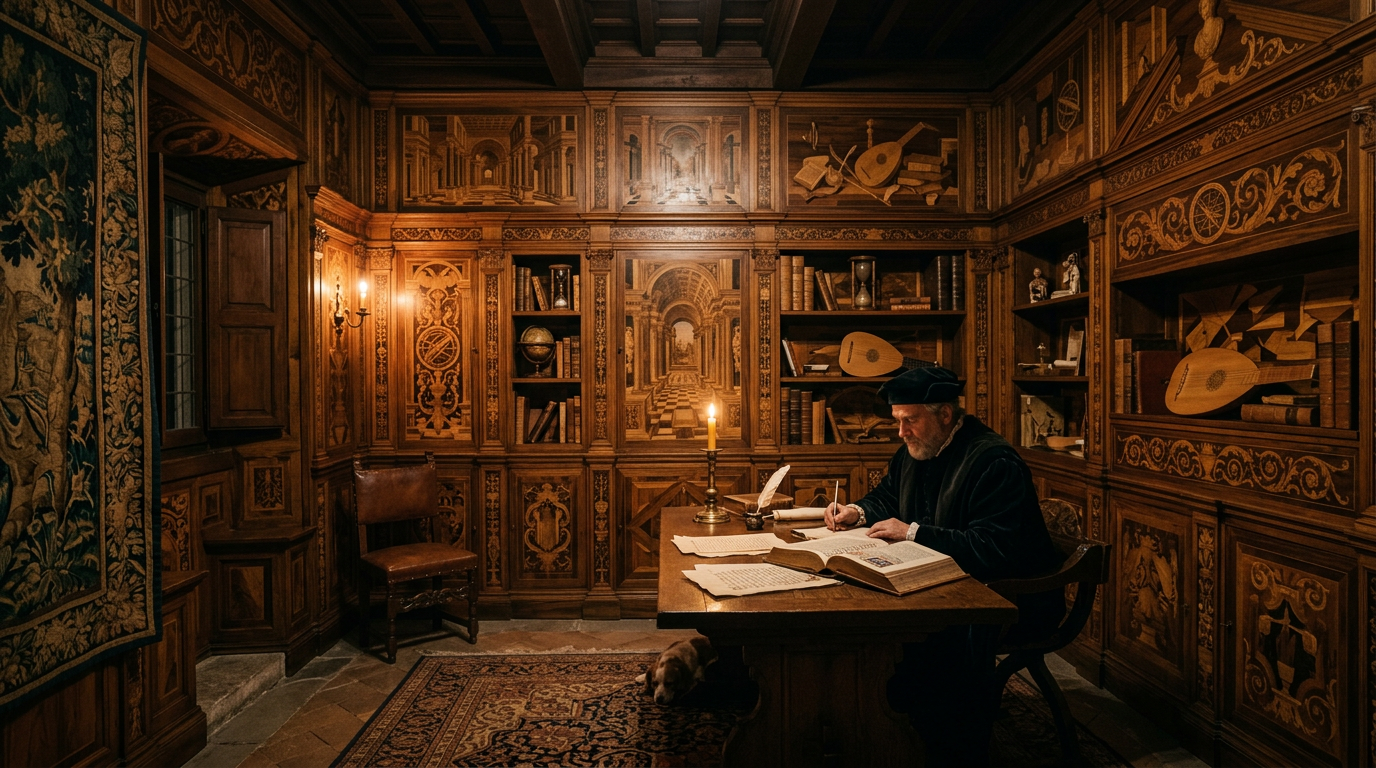
Renaissance Craft Meets Modern Art: The Marquetry Revival
By Darren Smith, Arts Reporter
May 12, 2026
In an age of instant digital imagery and AI-generated visuals, a growing cadre of contemporary artists is turning to the painstaking craftsmanship of the Renaissance—specifically the intricate woodworking techniques of marquetry and intarsia—to create works that demand time, touch, and tangible presence.
These artists are not merely nostalgic revivalists. They are raiding the Renaissance toolkit to confront the hyper-digital present, piecing together fragmented realities with wood, veneer, denim, and hybrid media. Their works assert materiality against the ephemerality of screens, offering “layers of aura” in a world of throwaway content.
The Enduring Allure of the Gubbio Studiolo
At the heart of this revival stands one of the Renaissance’s most astonishing achievements: the Studiolo from the Ducal Palace in Gubbio, now housed at the Metropolitan Museum of Art. Created around 1478–82 for Federico da Montefeltro, Duke of Urbino, this small room features breathtaking trompe l’œil intarsia—interlocking wood inlays depicting books, instruments, armor, and scholarly emblems with astonishing illusionism.
This wooden sanctum serves as a proto-Photoshop mood board for today’s artists, translating a patron’s inner world into symbolic form. Two leading figures—Alison Elizabeth Taylor and Michael Bühler-Rose—cite direct encounters with the Studiolo as pivotal to their practices.

Alison Elizabeth Taylor: Painting with Wood
Alison Elizabeth Taylor, a Brooklyn-based artist represented by James Cohan and Jessica Silverman, has pioneered what she calls “marquetry hybrid.” Trained as a painter, she self-taught the technique after seeing the Gubbio Studiolo in 2003. “I thought, I need to do that,” she recalls.
Taylor begins with photographs and life drawings, cuts one-to-one sketches into wood veneers, then layers in shellac, acrylic paint, oil, and collage. The results are richly textured tableaux that blend Renaissance precision with gritty contemporary subjects: foreclosed homes, urban resilience, female adolescence, and desert-city hybrids.

Her recent exhibition “I’ll Be Your Mirror” at Jessica Silverman (April 24–May 30, 2026) showcases this evolution, drawing on art-historical references like Manet while addressing modern vulnerabilities. Taylor’s sensitivity to the medium’s global history—studied during a Smithsonian fellowship—adds depth. Marquetry, once the “visual language of popes and kings,” has been dismissed as kitsch; she reclaims its power for the mundane and provocative.
“There is power in rendering the mundane in this medium because of its history,” Taylor explains. Her work counters the paralyzing hierarchies of fine art mediums, embracing “manual intelligence” in an era that prizes speed over skill.
Michael Bühler-Rose: Layers of Aura in Wood
Michael Bühler-Rose brings a unique biography to intarsia. Raised in the punk scene, he later became a Hare Krishna monk, spending years in India collaborating with Mysorean artisans. His return to New York and rediscovery of the Gubbio Studiolo fused these threads.
Bühler-Rose creates Photoshop composites of personal and aspirational objects—punk records, art books, ritual items—then translates them into polychrome wood inlays. The surprising natural colors of woods (yellows, reds, violets) enhance the trompe l’œil effect. His Studiolo series explores how images accrue “layers of aura,” countering photography’s reproducibility with wood’s weight and veracity.
At Independent New York (May 14–17, 2026), his solo booth with Stems Gallery featured multipaneled works referencing the Pictures Generation and conceptual art, blending owned objects with Photoshop additions. As adviser Benjamin Tischer notes, viewers experience initial visual draw followed by wonder upon realizing everything is raw wood.
Bühler-Rose’s process honors the deliberateness of Renaissance craft while interrogating image saturation, much like the artists who responded to media inundation decades ago.
Nick Doyle: Denim Marquetry and Digital Expansion
Nick Doyle extends the tradition into unexpected territory with denim-marquetry sculptures. His solo show “Collective Hallucinations” at Perrotin New York (April 24–May 30, 2026) features collaged denim works that filter American mythos—manifest destiny, westward expansion, toxic masculinity—through a Pop lens.

Doyle, who began with denim in 2017, uses Photoshop to map tonal scales, then bleaches, fades, stonewashes, and resins the fabric before mounting on wood. One piece overlays a chain-link fence on an Ansel Adams landscape, meditating on labor and imagery of expansion.
An immersive AI oracle named Ava in a denim-marquetry psychic’s booth complements the sculptures, linking handmade spirituality to digital colonization of the mind. “There is something spiritual about handmade things,” Doyle reflects, “especially as we deal with so many artificial things at this moment.”
Why Now? Materiality as Resistance
Adviser Liz Parks sees a broader trend: a return to craft as counter to hyper-technology. “One cannot snap one’s fingers and magically recreate an Alison Elizabeth Taylor artwork,” she notes. Collector Bob Bohlen, whose advocacy has helped legitimize wood art in museums, echoes this shift in perception.
These artists reclaim slowness and skill. In the Renaissance, intarsia and marquetry asserted patronage and order. Today, they assert presence amid fragmentation—piecing together identity, history, and future in an AI-saturated landscape.
Their works remind us that true innovation often involves looking backward to move forward, using centuries-old tools to craft something urgently new.
Cover image is Ai generated


