Maria Martins Breaks Auction Records with ‘Impossible’
By Darren Smith, Arts Reporter
June 5, 2026
In a landmark moment for modern art markets, Brazilian sculptor Maria Martins has claimed her place among the 20th century’s most vital voices. Her 1946 bronze Impossible sold for an astounding $3.17 million (including buyer’s premium) at Rago Wright on May 14, 2026 — more than tripling the pre-sale high estimate and obliterating her previous auction record of $329,000 set in 2014.
This dramatic leap signals a long-overdue reappraisal of a visionary artist whose sensual, mythic forms bridged Surrealism and the raw vitality of the Amazon. For decades, Martins hovered in the shadows of better-known male contemporaries. Now, her work commands attention on the global stage.
Maria Martins (1894–1973) was born Maria de Lourdes Alves in Campanha, Brazil. She trained initially as a musician before turning to sculpture in the 1930s while living abroad as the wife of a Brazilian diplomat. Her early exposure to European modernism fused with deep roots in Brazilian folklore and tropical nature produced a singular style — erotic, biomorphic, and often unsettling.
By the 1940s, living in New York, Martins had become a central figure in the Surrealist exile community. André Breton championed her. She exhibited alongside Max Ernst and André Masson. Most famously, she entered a passionate, decade-long relationship with Marcel Duchamp that profoundly influenced both artists. She is widely acknowledged as the model for the reclining nude in Duchamp’s enigmatic final masterpiece, Étant donnés.
Impossible stands as one of her most powerful statements from this fertile period. The earliest of three known versions — the others reside in the collections of MoMA and in Brazil — this bronze captures two hybrid figures locked in a tense, spiky embrace. Their elongated, tentacle-like forms suggest both erotic attraction and impossible separation, blending human anatomy with plant-like and animalistic elements drawn from Amazonian myth. At approximately 31 inches high, the work pulses with the expressive bronze casting that defines Martins’ mature style.
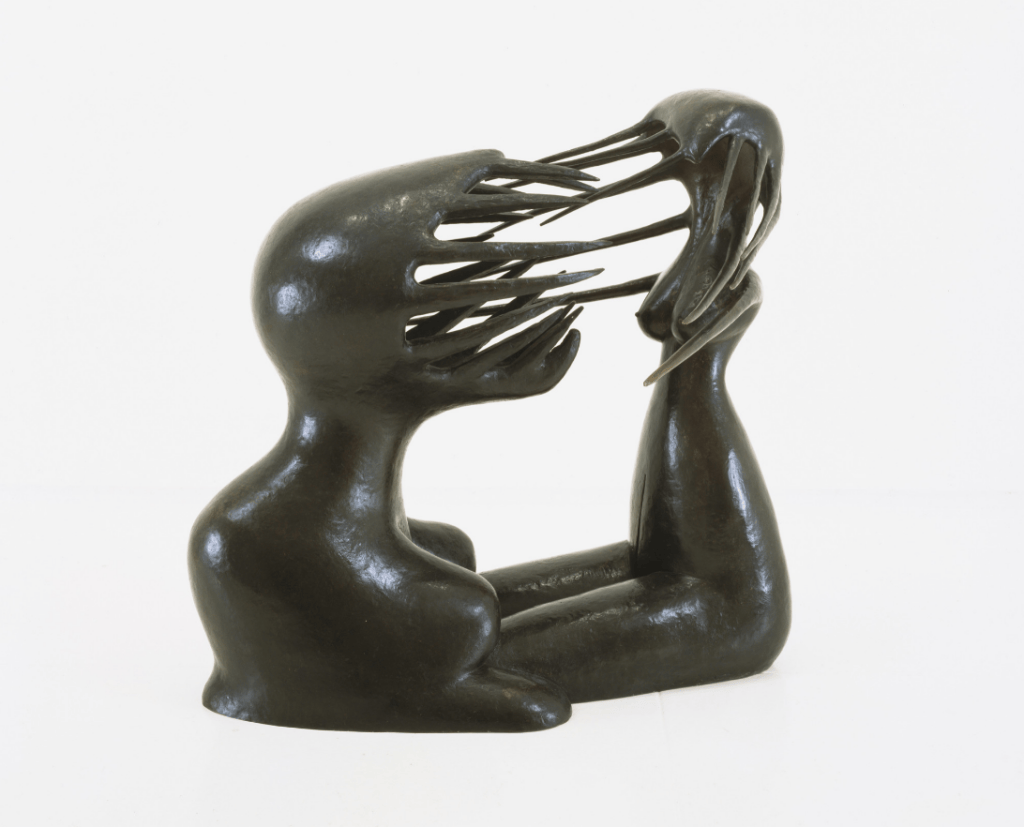
The sculpture’s re-emergence after decades in private hands created palpable excitement in the saleroom. Estimated conservatively at $150,000–$200,000, bidding ignited immediately. Multiple phone lines and determined internet participants drove the price skyward. When the hammer finally fell, the room erupted in applause — a rare emotional release at a Post-War & Contemporary sale.
This result not only elevates Martins but also marks a record single-day total for Rago Wright, underscoring growing collector appetite for overlooked female modernists and Latin American voices. As markets increasingly reward depth over hype, works like Impossible — fresh to auction, museum-quality, and rich with narrative — prove irresistible.

Art historians have long noted Martins’ importance. Her sculptures synthesize European Surrealism with Indigenous Brazilian cosmologies, creating hybrid beings that pulse with life force and psychological tension. Works often explore themes of transformation, desire, suffering, and the untamed power of nature — ideas that feel strikingly contemporary.
The Duchamp connection adds further intrigue. Their affair, documented in passionate letters, lasted from 1946 until Martins returned to Brazil in 1951. Scholars now view pieces like Impossible as visual poetry born from that intense personal and artistic dialogue.
Yet Martins was far more than a muse. She maintained an independent career, exhibiting internationally and continuing to produce ambitious commissions after returning to Rio de Janeiro. Her diplomatic life afforded her unusual freedom, which she channeled into a fearless artistic practice that challenged conventions of both gender and geography in mid-century art.
The record-breaking sale of Impossible arrives at a pivotal cultural moment. Institutions and collectors alike are actively diversifying holdings beyond the traditional Western canon. This auction catapults her into broader public consciousness and will likely inspire renewed museum interest and market activity for her remaining works.
For the wider art world, such moments reaffirm that great art eventually finds its value. Maria Martins refused to be confined — neither by diplomatic propriety, Surrealist cliques, nor the male-dominated narratives of her era. Her sculptures reach across time with undiminished vitality, demanding to be seen, touched, and felt.
As Impossible enters its next chapter in a distinguished private collection, it carries forward the artist’s legacy of sensual defiance and mythic imagination. The record price is impressive, but the real victory lies in recognition long deferred finally arriving with thunderous force.
The cover image in this article was AI-generated.