Russian Pavilion Sparks Controversy: Pussy Riot’s Bold Action
By Darren Smith, Arts Reporter
May 14, 2026
In the sun-dappled gardens of the Venice Giardini, where national pavilions stand as symbols of cultural diplomacy, a raw confrontation unfolded on May 6, 2026. Pussy Riot, the Russian feminist punk collective known for its fearless dissent, stormed the Russian Pavilion at the 61st Venice Biennale alongside activists from Ukraine’s FEMEN. What began as a high-octane protest against Russia’s return to the prestigious art event has now escalated into a pointed dispute over how that very protest is documented and displayed.
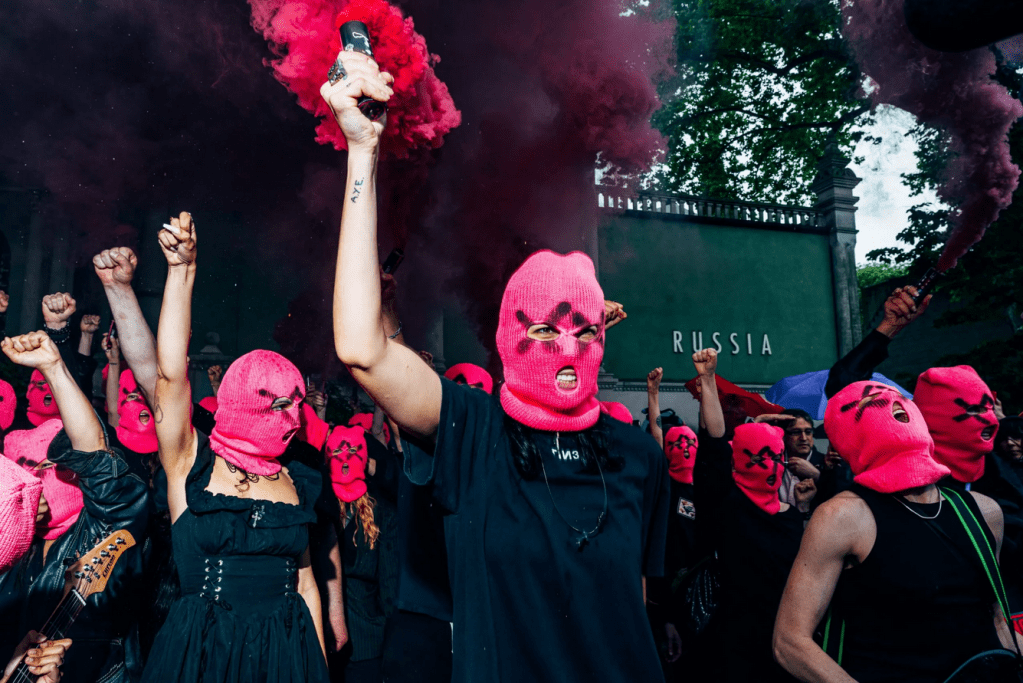
The images are unforgettable: dozens of figures in signature pink balaclavas, faces obscured, fists raised amid billowing clouds of pink, blue, and yellow smoke. Chants of “Blood is Russia’s art,” “Disobey,” and “Curated by Putin, dead bodies included” echoed through the grounds as protesters performed their new track Disobey, guitars in hand, bodies scrawled with slogans like “Russian art, Ukrainian blood.” Italian police formed a human barrier, preventing entry into the pavilion while the demonstration briefly forced its closure.
Nadya Tolokonnikova, Pussy Riot’s founding member, was at the forefront. “They’re drinking vodka and champagne in their pavilion, soaked in the blood of Ukrainian children,” she told reporters, framing the participation as an act of hybrid warfare. The group later offered to curate the 2028 Russian Pavilion using works by imprisoned Russian artists and political prisoners.

This protest was not isolated. Russia’s return to the Biennale — its first since the full-scale invasion of Ukraine in 2022 — has ignited fierce backlash. The event’s international jury resigned en masse amid debates over whether to consider pavilions from nations whose leaders face arrest warrants. European Union concerns over sanctions compliance added diplomatic tension, with some reports suggesting significant funding implications.
Yet the latest chapter in this saga is more introspective — and ironic. In a move that has sparked accusations of self-censorship, the Russian Pavilion claims Pussy Riot demanded the removal of footage featuring their protest from an official documentary about the project.
“Pussy Riot asked us to remove the footage featuring them from the documentary film about the project,” the pavilion posted on Instagram, overlaying text reading “Censored on request by Pussy Riot.” “They wrote that they do not want their protests shown in the Pavilion… strange. We wanted to be honest and show what really happened, but it’s turning into pure self-censorship.”
The statement, dripping with sarcasm, has ignited a fresh war of words. For a collective whose identity is built on unfiltered provocation and media visibility, the request raises eyebrows. Critics see it as an attempt to control the narrative or avoid lending legitimacy to the pavilion’s documentation. Supporters argue it prevents the occupiers from co-opting the protest imagery for their own ends.
Pussy Riot has not issued a detailed public rebuttal in mainstream outlets as of this writing, but their history suggests a strategic approach to documentation. The group has long weaponized media, from cathedral performances to global headlines, yet remains wary of how authoritarian structures might twist their actions.
The Russian Pavilion itself, housed in a neoclassical structure amid lush greenery, opened despite the uproar. Its participation reflects Moscow’s determination to maintain cultural soft power even amid international isolation. Organizers inside emphasized artistic autonomy, but the surrounding chaos made clear that art and geopolitics are inseparable here.

This episode highlights deeper fractures in the contemporary art world. The Venice Biennale, often called the “Olympics of the arts,” has historically been a stage for political expression — from 1968 student protests to Chile-focused editions in the 1970s. Today, with ongoing conflicts in Ukraine and Gaza, such intersections feel more urgent than ever. Over 200 participants signed open letters demanding cancellations or boycotts, while some national delegations navigated delicate balances between solidarity and programming commitments.
Pussy Riot’s actions resonate with their legacy. Formed in 2011, the group gained international fame after a 2012 punk prayer in Moscow’s Christ the Saviour Cathedral, leading to imprisonment for members on hooliganism charges. Tolokonnikova and others have endured harassment, exile, and legal battles, transforming personal risk into global symbols of resistance. Their alliance with FEMEN — known for topless protests — amplified the visual and symbolic power of the Venice action, blending performance art with direct confrontation.
The footage dispute adds a meta-layer: in an era of pervasive recording, who owns the image of dissent? By asking for removal, Pussy Riot may seek to deny the pavilion any aura of edgy authenticity or to protect the protest’s purity from institutional framing. The pavilion’s response cleverly flips the script, positioning itself as the transparent party while painting activists as inconsistent.
Art critics and observers note the irony. “Protest art thrives on visibility,” one commentator observed, “yet controlling that visibility risks diluting its raw edge.” Others praise the move as savvy brand management in a hyper-mediated landscape.
As the Biennale runs through November, the Russian Pavilion continues to draw visitors — and protesters. Additional demonstrations have targeted both Russian and Israeli pavilions, underscoring how this edition has become a referendum on cultural boycotts and the limits of artistic neutrality.
The spar over protest footage encapsulates a broader tension: in today’s polarized world, even documentation becomes a battleground. Pussy Riot’s pink smoke may have dissipated, but the questions it raised — about complicity, representation, and the ethics of display — linger in the Venetian lagoon.
What do you think? Should protest footage be included in official pavilion documentaries, or does that constitute co-optation? Share your views in the comments, follow developments on ARTnews, and support independent journalism covering art and human rights. Subscribe for more in-depth reporting from the frontlines of culture and conflict.
Cover image is Ai Generated