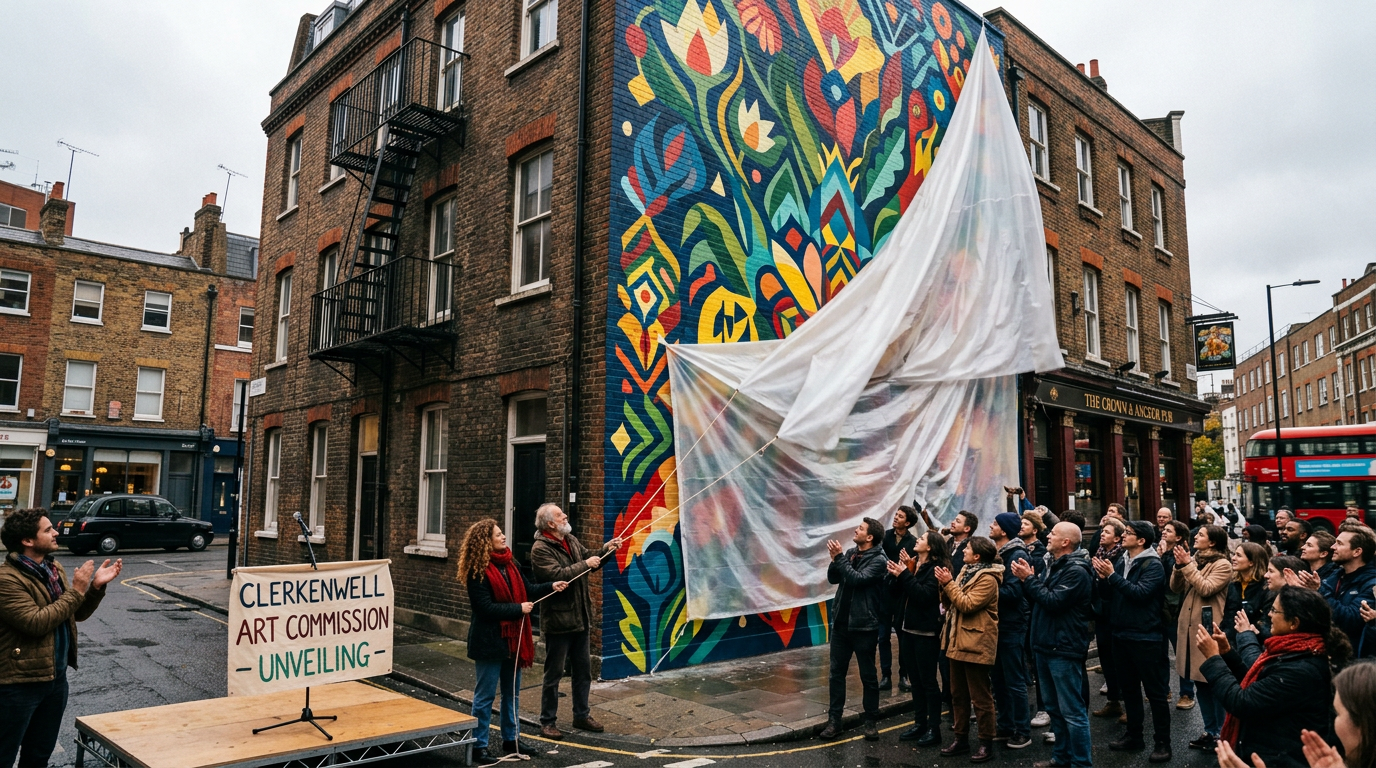
Quentin Blake Unveils New Mural at Illustration Centre
By Darren Smith, Arts Reporter
June 1, 2026
In the heart of historic Clerkenwell, where London’s ancient waterways once shaped the rhythms of daily life, a landmark moment in the world of illustration has unfolded. Sir Quentin Blake, the beloved 93-year-old artist whose whimsical ink lines have enchanted generations through more than 500 books, has unveiled a striking new mural titled A Bridge to the Past. This large-scale work, created specifically for the café of the forthcoming Quentin Blake Centre for Illustration, stands as both a celebration of the site’s layered history and a testament to Blake’s enduring creative vitality.
The mural’s public reveal, which took place just days ago as the centre prepares to open its doors on June 5, marks a significant milestone not only for Blake but for the broader recognition of illustration as a vital artistic discipline. Housed within the restored Grade II-listed buildings of New River Head—an 18th-century waterworks complex that once formed the terminus of Sir Hugh Myddelton’s ambitious engineering project from the early 1600s—the centre promises to become the UK’s first permanent public venue dedicated exclusively to illustration. For Blake, who founded the supporting charity in 2002, this project represents the culmination of decades of advocacy for an art form often overshadowed by more traditional fine arts.
Blake, seated in his wheelchair during the unveiling, gazed at the nearly five-metre-wide ink drawing with the quiet satisfaction of an artist who has never stopped evolving. “I was especially pleased to be asked to produce a mural for the Quentin Blake Centre’s café,” he remarked. “You will see that I have drawn a bridge. It does not actually exist, but I needed one to act as a bridge to the past.” Crossing this imaginary structure are figures drawn from across centuries—men, women, and children in period costumes, all invented by Blake except for two fishermen borrowed from an 18th-century print. These characters evoke the social history of the New River, which supplied clean water to London from Hertfordshire starting in 1613, serving not just as infrastructure but as a place of leisure, reflection, and community gathering.
The work captures Blake’s signature style: fluid, expressive lines that convey movement, personality, and gentle humour even in a monumental format. Scaled up from his original drawing for prominent display in the café, the mural invites visitors to pause, sip coffee, and imagine the lives intertwined with this once-vital waterway. Its placement within the centre underscores a deeper theme—the continuity between past and present, between utility and imagination, and between the hidden histories of a neighbourhood and the vibrant future of illustration as a public art.
To fully appreciate the significance of this mural, one must step back into the extraordinary career of its creator. Born Quentin Saxby Blake on December 16, 1932, in Sidcup, Kent, the artist displayed a precocious talent from childhood. His first illustration was published in Punch magazine in 1949 while he was still a schoolboy. After national service and studies in English at Cambridge, followed by teacher training and time at Chelsea School of Art, Blake embarked on a path that would redefine children’s literature.
His collaboration with Roald Dahl, beginning in the 1970s, produced some of the most iconic imagery in modern publishing. From the enormous, friendly giant in The BFG to the mischievous antics in Matilda and the chocolate factory wonders of Charlie and the Chocolate Factory, Blake’s drawings brought Dahl’s words to vivid, unforgettable life. Global sales of books he has illustrated have exceeded 45 million copies, earning him prestigious honours including the Hans Christian Andersen Award in 2002—the highest international recognition for children’s book creators—the Kate Greenaway Medal, and a knighthood in 2013 for services to illustration.
Yet Blake’s contributions extend far beyond commercial success. As the first Children’s Laureate from 1999 to 2001, he championed the importance of visual storytelling in education and culture. He has created murals for hospitals, galleries, and community spaces, always emphasizing accessibility and joy. His teaching tenure at the Royal College of Art, where he headed the illustration department, influenced generations of artists. Even now, in his nineties, Blake draws every day, maintaining the spontaneous energy that defines his work.
The new centre in Clerkenwell builds directly on this legacy. Previously operating from more modest premises in King’s Cross, the organisation has transformed the historic waterworks site into a world-class destination. Visitors will find three galleries for rotating exhibitions, a free illustration library, landscaped gardens, a shop, and the café where Blake’s mural will serve as a welcoming focal point. The opening exhibition features the kaleidoscopic works of Sri Lankan artist and designer MURUGIAH, whose vibrant, pop-culture-infused pieces promise an exciting start to the programme.
This development comes at a time when illustration is experiencing renewed global appreciation. Digital tools have expanded the field, yet the tactile, narrative power of hand-drawn work retains a special magic—something Blake has always understood intuitively. His mural at the centre not only honours the New River’s engineering heritage but also bridges the gap between fine art institutions and the more democratic world of illustrated stories, comics, graphic novels, and editorial work.
Art historians and critics have long noted how Blake’s loose, energetic style—often achieved with rapid pen strokes and expressive washes—conveys emotion with remarkable economy. In A Bridge to the Past, this technique shines as figures bustle across the imaginary span, their postures and interactions hinting at stories untold. The inclusion of the two fishermen, faithfully adapted from historical sources, grounds the fantasy in reality, much like Blake’s best children’s illustrations root whimsical tales in universal human experiences.

The centre’s location adds poetic resonance. New River Head, with its preserved engine house and historic structures, was never before open to the public in this way. Its transformation into a cultural hub reflects broader efforts to revitalise London’s hidden heritage sites while creating inclusive spaces for creativity. Early visitors will have the chance to engage directly: the first 50 on opening day receive free entry by completing an illustration on a special voucher, echoing Blake’s belief in participatory art.
Funding and support for the project have come from a mix of public grants, private donations, and Blake’s own advocacy. The charity behind the centre has emphasised its mission to celebrate illustration’s traditions while embracing its astonishing diversity worldwide. Plans include exhibitions that will showcase everything from classic book art to contemporary digital practices, educational programmes for schools, and community workshops.
For those familiar with Blake’s hospital murals—such as the vibrant installations that bring colour and narrative to children’s wards—this café piece represents a continuation of his commitment to art in everyday spaces. Where patients once found solace in his drawings, future café patrons at the centre will encounter a work that connects them to London’s watery past and the flowing creativity of illustration itself.
Blake’s influence on British culture is difficult to overstate. His characters have become cultural touchstones, appearing in adaptations, merchandise, and even public sculpture. Yet he remains remarkably humble, still sketching daily and finding fresh inspiration in the world around him. In interviews over the years, he has spoken of the joy of drawing as a fundamental human impulse—one that the new centre aims to nurture across all ages.
As London’s art scene continues to evolve amid economic and cultural shifts, initiatives like the Quentin Blake Centre stand out for their focus on accessibility and education. Ticket prices are set at a reasonable £16.50 for adults, with concessions available, ensuring broad appeal. The venue’s Wednesday-to-Sunday hours will accommodate both locals and international visitors drawn to Clerkenwell’s creative quarter.

The mural’s creation process itself offers insight into Blake’s working methods. Starting with ink on paper, the image was meticulously enlarged while preserving every spontaneous mark and flourish. This fidelity to the original drawing ensures that viewers experience the artist’s hand directly, even at monumental scale—a rare achievement in public art.
Looking ahead, the centre’s programme promises depth and variety. Beyond the inaugural MURUGIAH exhibition, future shows will draw from Blake’s extensive personal archive and international contributors. Educational initiatives will partner with schools to inspire young illustrators, while the library will provide free access to rare books and reference materials.
In an era dominated by digital imagery, Blake’s steadfast commitment to the physical act of drawing feels both nostalgic and revolutionary. His work reminds us that illustration is not merely decoration but a powerful form of communication capable of crossing boundaries of language, age, and culture. A Bridge to the Past embodies this philosophy, linking Clerkenwell’s industrial heritage with the imaginative leaps that define great storytelling.
The unveiling has already generated excitement across the arts community. Fellow illustrators, publishers, and cultural leaders have praised the project as a long-overdue recognition of the medium’s importance. For Blake personally, it represents a joyful homecoming of sorts—the establishment of a lasting institution bearing his name, dedicated to the art he has championed lifelong.
As the June 5 opening approaches, anticipation builds for what this new cultural landmark will bring to London. The combination of historic architecture, world-class exhibitions, and Blake’s own vibrant mural creates a compelling destination for anyone who values creativity, history, and the simple pleasure of a well-told visual story.
Those inspired by this news are encouraged to visit the Quentin Blake Centre for Illustration website at qbcentre.org.uk to learn more, purchase tickets, or support the charity’s ongoing work. Plan your visit soon—whether to see A Bridge to the Past in person, explore the galleries, or simply draw your own illustration and become part of this exciting new chapter in London’s artistic landscape. The bridge to the past is open; the future of illustration awaits.
Cover image has been Ai generated


