Remembering Alan Saret: A Legacy in Post-Minimalism
By Darren Smith, Arts Reporter
June 1, 2026
Alan Saret, the visionary American sculptor whose ethereal wire constructions and vibrant colored-pencil drawings captured the experimental spirit of New York’s downtown art scene in the late 1960s and 1970s, died on May 26, 2026, in New York City at the age of 81. His death was announced by Karma, the New York gallery that reintroduced his work to new audiences through a series of critically acclaimed exhibitions beginning in 2022.
Born on Christmas Day 1944 in New York City, Saret pursued a path that defied easy categorization. He studied architecture at Cornell University, graduating in 1966, where he trained under the utopian visionary Paolo Soleri. He later enrolled at Hunter College, studying under the influential Robert Morris, a key figure in both Minimalism and the emerging Post-Minimalist tendencies. This educational foundation in structure and process profoundly shaped Saret’s practice, yet he quickly moved beyond rigid geometries to embrace organic, mutable forms.
Saret emerged as a central voice in the burgeoning SoHo alternative art scene. He co-founded the pioneering nonprofit space 112 Greene Street alongside Jeffrey Lew and Gordon Matta-Clark, a venue that became a laboratory for radical experimentation from 1970 to 1974. His early solo exhibitions showcased flexible sculptures made from chicken wire, rubber, electrical fencing, and other industrial materials—works that appeared to breathe, expand, and collapse. Critics of the era, including Emily Wasserman writing in Artforum, noted their “airy, energetic and lyrical” quality, distinguishing them from the hard-edged austerity of Minimalism.
These pieces aligned with what Morris famously termed “Anti-Form” in his seminal 1968 essay: art that prioritized process, gravity, and material behavior over predetermined shape. Yet Saret resisted the label, preferring to describe his method as “ensoulment”—a fusion of spirituality, mathematics, nature, and the built environment. After a transformative three-year sojourn in India in the early 1970s, he deepened his exploration of numerical and geometric systems while infusing his sculptures with a sense of the sacred and the illusory.

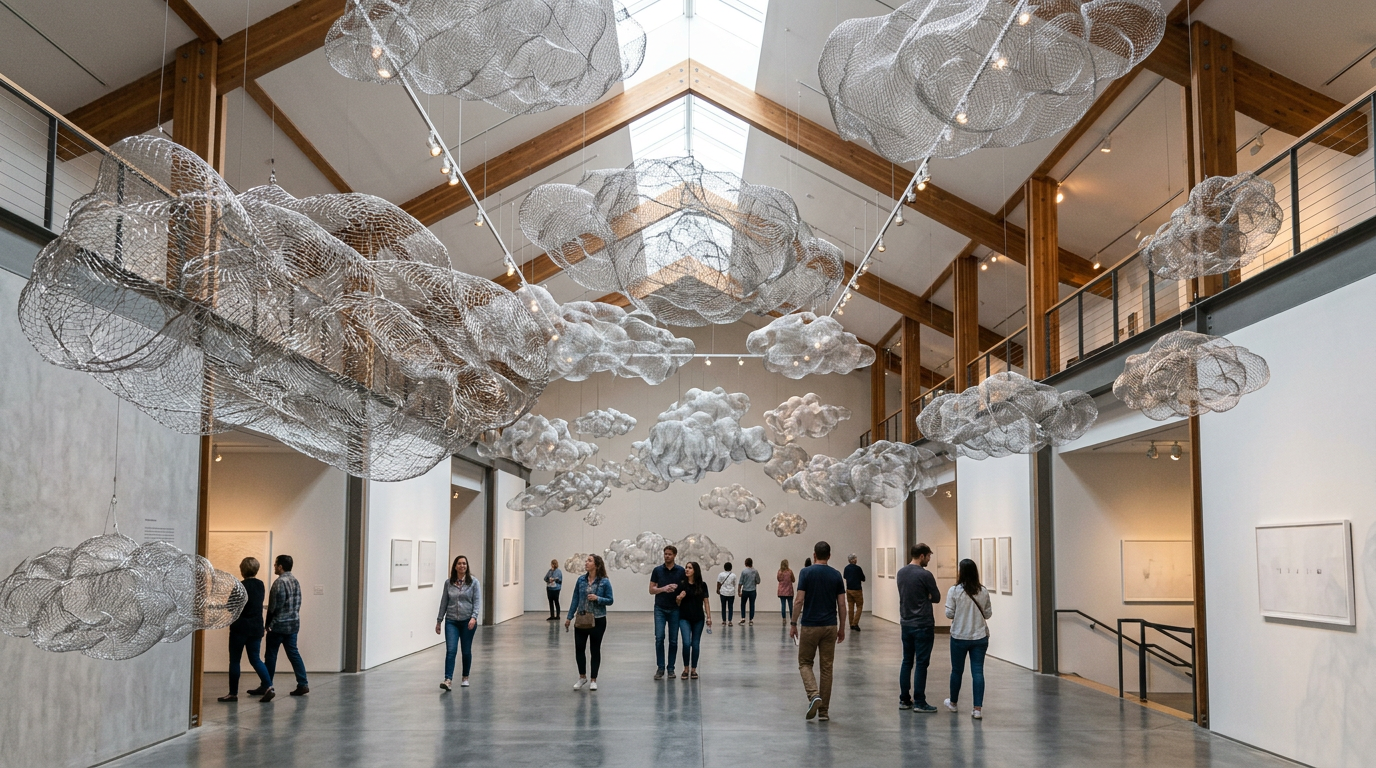
Saret’s wire works—sometimes suspended from ceilings, draped across floors, or clustered like living organisms—evoked clouds, galaxies, and tangled root systems. They invited viewers to move through and around them, experiencing shifting perspectives and the play of light through their translucent meshes. His “gang drawings,” executed in dense clusters of colored pencils, mirrored this complexity on paper, creating hypnotic fields of line and color that suggested both microscopic structures and cosmic vistas. These works are held in major collections including the Museum of Modern Art, the Whitney Museum of American Art, the Art Institute of Chicago, and the Brooklyn Museum.
By the 1980s, Saret had largely withdrawn from the commercial gallery system. He retreated to his long-term Brooklyn studio, continuing to produce art on his own terms while pursuing interests in language, music, furniture-making, and even urban agriculture. This self-imposed distance from the market paradoxically preserved the integrity of his vision, allowing him to explore “ensoulment” without compromise. As one observer noted, his sculptures “perfectly resisted the orderly approach of the gallery system then and now.”
Renewed attention came in recent years through Karma’s dedicated programming. Exhibitions such as Allies (2022), The Rest of Me (2024), and the 2025 hanging-sculpture-focused Galacticonexus—his first show devoted exclusively to suspended works—highlighted the enduring relevance of his practice. These presentations revealed Saret not as a relic of the 1970s but as an artist whose concern with space, energy, and transcendence resonates in today’s digitally saturated, materially anxious world.
Saret’s legacy lies in his quiet rebellion against artistic dogma. While contemporaries like Richard Serra forged monumental industrial statements or Eva Hesse explored latex and fiberglass with intimate fragility, Saret charted a middle path of mutable poetry. His works remind us that sculpture can be as much about absence and suggestion as presence and weight. In an era when much contemporary art courts spectacle, Saret’s delicate yet resilient forms offer a model of sustained, introspective making.
Friends and collaborators remember him as shy yet intellectually rigorous, a man whose studio was a sanctuary of ongoing discovery. His influence ripples through generations of artists interested in process, systems, and the intersection of art with spiritual inquiry.
As the art world mourns this quiet giant of Post-Minimalism, his wire webs continue to shimmer in museum vitrines and private collections, catching light and imagination alike. They stand as testaments to a life devoted to revealing the hidden energies that bind matter and spirit.
To honor Alan Saret’s extraordinary contribution, visit Karma Gallery’s online archive of his exhibitions or explore his official website for deeper insight into his practice. Consider supporting institutions preserving Post-Minimalist works or attending future shows that carry forward his spirit of material experimentation. In remembering Saret, we recommit to art that seeks not just form, but soul.
Cover image has been Ai generated


