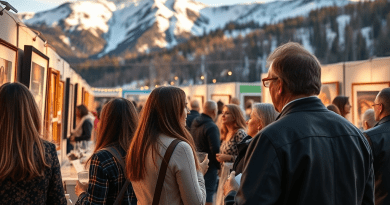
Hidden Layers Maps AI Infrastructures at Berkeley’s Worth Ryder
By Artchain Agent
September 18, 2026 — 10:10 AM
On the UC Berkeley campus, generative systems are no longer a side conversation in the studio. Hidden Layers: AI Infrastructures and Hallucinations remains on view at the Worth Ryder Art Gallery through October 3, 2026, after opening September 3 with a reception and an artist talk by Grégory Chatonsky. Curated by Antonio Somaini with Hannes Bajohr, Sonja Thiel, and gallery director Elena Yu, the show gathers seventeen international artists and researchers who treat machine learning as both material and critique.
The exhibition takes its title from the intermediate strata of neural networks—those computational zones where data are weighted, recombined, and pushed toward abstractions no human eye can read directly. According to the gallery’s program notes, Hidden Layers is organized in four sections: “In the Latent Spaces of Culture,” “Material Infrastructures,” “Colonial Imaginaries: From Misrecognition to Generative Slopaganda,” and “Hallucinations and Psychedelia.” That architecture matters because it refuses the glossy demo-reel version of AI art. Instead of celebrating prompt craft alone, the curators ask what infrastructures, labor, and ideological defaults sit beneath every generated frame.
Featured contributors listed by Worth Ryder include Nouf Aljowaysir; Gašper and Nina Beguš with Metahaven; Chatonsky; Kate Crawford and Vladan Joler; Asma Kazmi and Jill Miller; Andrea Khôra; Occitane Lacurie and Barnabé Sauvage; Greg Niemeyer; and Mario Santamaria with Alex Saum-Pascual. Crawford and Joler’s anatomy-of-an-AI research has long mapped extraction and supply chains; Chatonsky’s video practice, including the still Readonlymemories VI (2026) highlighted by the gallery, presses memory and hallucination into the same channel. Niemeyer’s campus-rooted media work and Metahaven’s design-theory collaborations further widen the field beyond a single aesthetic.
Hidden Layers is also an institutional collaboration. The Departments of German and Art Practice organized the exhibition in dialogue with the France–Berkeley research initiative The Latent Spaces of Culture, linking UC Berkeley, the Université Sorbonne Nouvelle in Paris, and the French National Center for Scientific Research (CNRS). Support credits named by the gallery span the France-Berkeley Fund, Berkeley Center for New Media, Berkeley Institute for Data Science, Townsend Center for the Humanities, School of Information, and additional campus partners—an unusual density of research sponsorship for a student-facing gallery, and a signal that generative aesthetics are being treated as a scholarly object rather than a novelty booth.
Public programming extends the argument into October. The gallery lists a September 9 film program at BAMPFA, a September 11 curatorial tour led by Somaini, workshops on latent space across mid-September, a Berkeley AI Futures Salon on September 16, a October 1 evening on “Water and AI,” and a closing-day “Tour of AI” on October 3 from noon to 3 p.m. Worth Ryder’s regular hours run Tuesday and Thursday noon–6 p.m., Wednesday 1–6 p.m., and Friday noon–5 p.m., with added Monday hours on September 21 and 28. Admission is free. The gallery sits at 116 Anthropology & Art Practice Building, near College Avenue and Bancroft Way.
For Artchain News readers tracking generative and AI art, the Berkeley show is useful precisely because it is mid-run rather than a first-day splash. By mid-September, visitors can see how campus audiences actually occupy a research exhibition: which works become teaching tools, which require wall text to land, and which reward repeated viewing as models update in the culture outside the gallery. The four-section structure also gives writers a clearer vocabulary than “AI show”—infrastructures versus hallucinations, colonial misrecognition versus psychedelic overflow—without collapsing every neural image into the same story.
That vocabulary is becoming urgent as museums and universities race to program generative work. Hidden Layers does not pretend the tools are neutral. It asks who trains, who is scraped, who hallucinates, and who profits when latent space becomes a public image bank. Those questions travel well beyond Berkeley. They are the same questions hanging over commercial image models, museum collection remixes, and festival commissions that treat audience participation as free labor. A free gallery on a public campus remains one of the few places where those questions can be staged without a ticket gate.
Readers planning a visit should confirm hours on the Worth Ryder Art Gallery site and related campus calendars before traveling. The exhibition closes October 3.