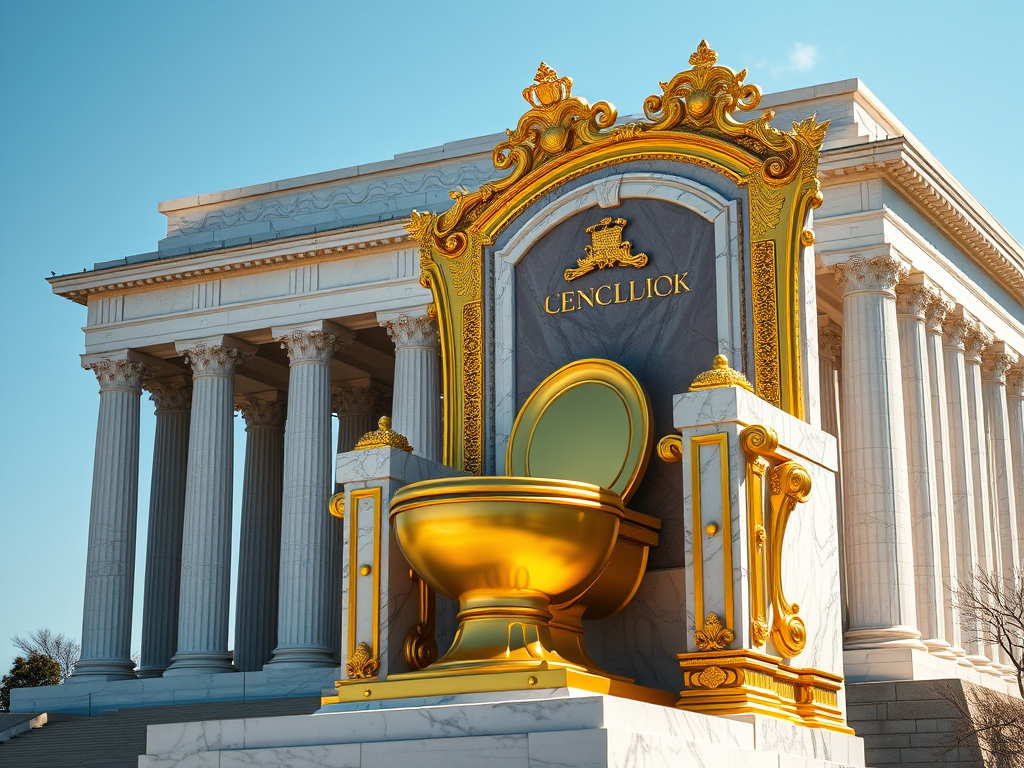
Giant Golden Toilet Sculpture Emerges Near Lincoln Memorial in Bold Political Satire
WASHINGTON, D.C. — A towering 10-foot-tall sculpture resembling an ornate marble throne fitted with a gleaming golden toilet has appeared on the National Mall near the Lincoln Memorial, sparking immediate attention as a sharp critique of President Donald Trump’s White House renovations.
Titled “A Throne Fit for a King,” the installation was unveiled on March 30 by the anonymous artist collective The Secret Handshake. The group, previously known for a provocative statue depicting Trump and Jeffrey Epstein in a Titanic-inspired pose, described the work as using humor and spectacle to highlight political priorities amid national challenges.

The installation directly references Trump’s much-discussed renovation of the Lincoln Bedroom bathroom, which drew public mockery for its opulent redesign during a period of government scrutiny.
A visitor in a MAGA hat poses on the golden toilet sculpture near the Lincoln Memorial, with the Washington Monument visible in the background. (Photo credit: Reuters/Evelyn Hockstein via ARTnews and related coverage)
Art observers note echoes of Maurizio Cattelan’s infamous 18-karat gold toilet “America,” which itself became a symbol of wealth and excess. Yet this pop-up piece grounds its satire firmly in current events, blending contemporary protest art with the monumental scale of Washington’s iconic landscape.
The Secret Handshake confirmed via email that the work would remain on view for several days on the southwest side of the Lincoln Memorial steps. Passersby have already engaged with it, snapping photos and debating its message in a city no stranger to politically charged public art.
Critics and supporters alike see the sculpture as part of a broader tradition of activist interventions on the National Mall, where temporary works challenge power and provoke discourse. As one onlooker remarked, “It’s absurd, but it makes you think.”
The appearance comes days after nationwide protests and amid ongoing debates over presidential priorities. Whether celebrated as clever commentary or dismissed as mere spectacle, “A Throne Fit for a King” has succeeded in drawing eyes—and conversations—to the intersection of art, politics, and public space.


