Controversial End for SF’s Vaillancourt Fountain Amid Dismantling
By Darren Smith, Arts Reporter
May 9, 2026
In a dramatic turn that seemed almost poetic for one of San Francisco’s most polarizing public artworks, flames and thick black smoke billowed from the Vaillancourt Fountain this week as crews dismantled the massive Brutalist sculpture in Embarcadero Plaza. The incident, which occurred on May 6 during routine torch-cutting operations, underscored the contentious end of a 55-year landmark that has sparked debate, protests, and even rock-star graffiti since its 1971 debut.
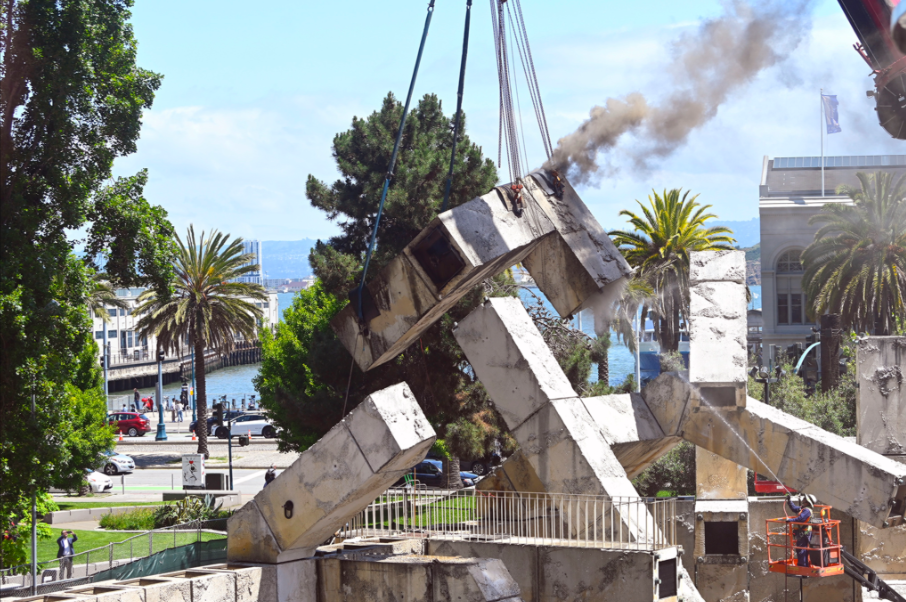
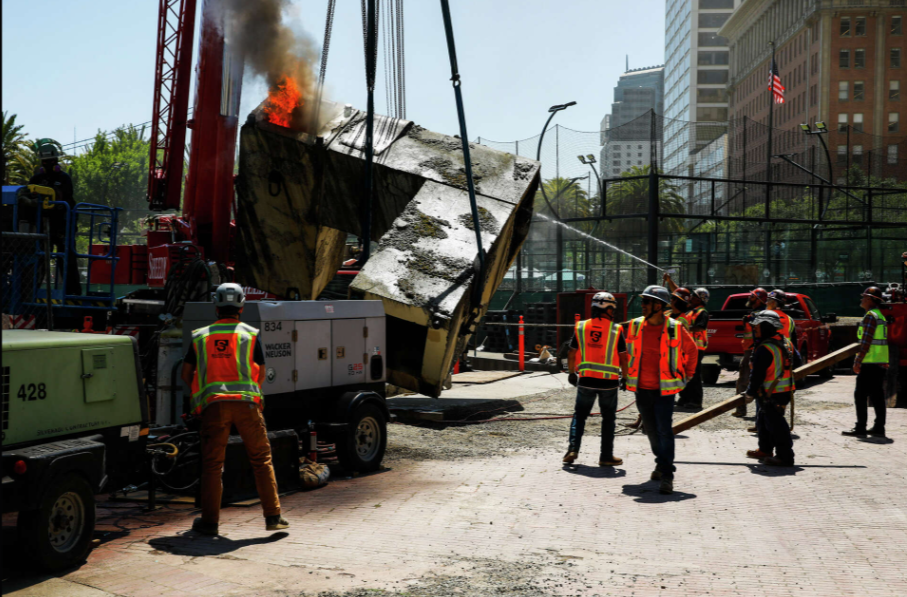
The fire erupted as workers from Silverado Construction used blowtorches to sever one of the fountain’s 10-ton cantilevered concrete arms. According to a spokesperson for the San Francisco Arts Commission, “During torch-cutting activity, debris inside the tubes ignited.” Internal rubber tubing and accumulated material acted like a chimney, sending sparks and flames shooting upward. Crews quickly extinguished the blaze using on-site extinguishers and water lines, with no injuries reported and “no major damage” to the structure itself. Dismantling resumed shortly after, but the episode has reignited passions over the fountain’s fate.
Designed by Québécois artist Armand Vaillancourt in collaboration with landscape architect Lawrence Halprin, the 710-ton, 40-foot-tall fountain was commissioned as the centerpiece of the newly developed Embarcadero Plaza. Vaillancourt, then a rising star in avant-garde sculpture, inscribed the phrase “Québec libre!” on the structure the night before its dedication—a bold political statement supporting Quebec independence that instantly transformed the work into a symbol of free speech and artistic defiance. Over the decades, the fountain has endured (and sometimes embraced) controversy. Critics derided it as a “loathsome monstrosity” upon unveiling, while supporters praised its raw, industrial poetry. In 1987, U2 frontman Bono famously spray-painted “Stop the Traffic, Rock the Boat” across it during an impromptu concert, cementing its place in pop-culture lore.
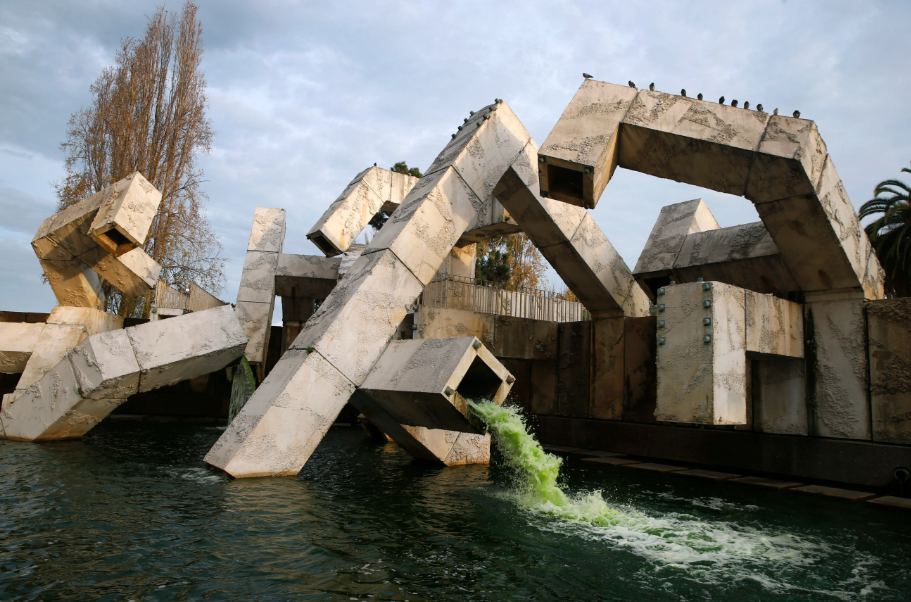
Yet maintenance woes plagued the fountain for years. Water pumps failed repeatedly, most recently in 2024, leaving the once-vibrant cascades dry. Structural corrosion, asbestos in the concrete, and lead paint raised safety concerns, prompting the San Francisco Recreation and Park Department to recommend removal. In November 2025, the San Francisco Arts Commission voted to deaccession and dismantle the piece, citing an estimated $29 million repair bill and risks to public safety. The decision cleared the way for a $35–40 million redesign of Embarcadero Plaza and adjacent Sue Bierman Park, set to begin construction in late 2026 or early 2027. Read the full SF Chronicle report on the fire here.
Preservationists and the artist himself fought fiercely against the move. The 96-year-old Vaillancourt, who traveled from Montreal to plead his case, described the potential loss as devastating. A coalition including Friends of the Plaza filed lawsuits, securing a temporary stay before the California Court of Appeal denied it in early May 2026, allowing work to begin on May 4. Jack McCarthy of Friends of the Plaza criticized the handling of hazardous materials, noting workers appeared without respirators or protective gear during the fire incident and questioning the lack of air-quality permits or public warnings. “The city spent the last year arguing that the fountain was riddled with asbestos and needed to be removed for safety,” McCarthy said. “Yet they’re doing it in open air without proper precautions.” Explore the fountain’s history on Wikipedia.
City officials maintain the process is safe and necessary. Coma Te, the Arts Commission’s communications director, emphasized that sparks are an expected byproduct of the disassembly. The 10-ton arms are being transported to off-site storage for up to three years at a cost of approximately $4 million. During that time, experts will study the sculpture’s deterioration and evaluate long-term options—potentially including relocation, partial reconstruction, or other creative repurposing—before a final decision. See coverage from The Art Newspaper.
The episode highlights broader tensions in San Francisco’s approach to public art: balancing heritage preservation with urban renewal, safety, and fiscal responsibility. Supporters of removal argue the fountain had become a magnet for homelessness and blight in recent years, while advocates see its dismantling as a cultural erasure. As one passerby near the padel courts at Ferry Plaza observed during the fire, the sight was “surreal—like watching a piece of the city’s soul go up in smoke.”
With the plaza redevelopment on the horizon, the Vaillancourt Fountain’s story is far from over. Its stored components may yet find new life, but for now, the fiery dismantling marks a visceral chapter in the ongoing debate over what San Francisco chooses to remember—and what it lets go. Learn more about the artist and preservation efforts via Artnet. Full Artforum dispatch on the removal controversy.
What do you think? Should iconic but challenged public artworks like the Vaillancourt Fountain be preserved at all costs, or does practical urban progress take precedence? Share your thoughts in the comments below, subscribe to ArtChain News for daily updates on public art battles, and follow us on X for real-time coverage from the front lines of cultural preservation.