Exploring Frankenthaler’s Impact at Kunstmuseum Basel
By Darren Smith, Arts Reporter
June 19, 2026
In the luminous galleries of the Kunstmuseum Basel, Helen Frankenthaler’s color-soaked canvases command attention like never before. The American abstractionist’s major survey, on view through August 23, stands as the largest exhibition of her work ever mounted in Europe and her first institutional solo show in Switzerland. More than fifty works spanning six decades trace Frankenthaler’s (1928–2011) evolution from pioneering innovator to a lifelong explorer of painting’s possibilities.
Born into a cultured New York family, Frankenthaler emerged in the 1950s amid the raw energy of Abstract Expressionism. At just twenty-three, she invented her groundbreaking soak-stain technique, pouring thinned paint onto unprimed canvas laid on the studio floor. The pigments soaked directly into the fabric, merging color and support in translucent, luminous veils. This radical method, first seen in her landmark Mountains and Sea (1952), helped birth Color Field painting and liberated abstraction from the heavy impasto of her male contemporaries.
The Basel exhibition, curated by Anita Haldemann, goes beyond chronology. It illuminates Frankenthaler’s deep dialogue with art history, particularly Old Masters she encountered during formative European travels. Visitors encounter her paintings hung alongside works by Titian, Édouard Manet, and others that inspired her “paraphrases.” In For E.M. (1981), for instance, she transforms Manet’s Fish (Still Life) into monumental blocks of color and gesture, retaining the original’s vitality while exploding its scale. Nearby, Europa (1957) reimagines Titian’s mythic scene through swirling pinks and whites that carry visceral weight.
These juxtapositions reveal Frankenthaler not as an isolated genius but as a voracious student of the past who translated its lessons into a thoroughly modern language. Her 1953 trip to Spain left her captivated by Altamira’s cave paintings; later visits to the Prado and Louvre sharpened her eye for light, space, and gesture. “Scale and the play of space and light are largely what it’s all about,” she once reflected. The exhibition makes that philosophy visible across rooms dedicated to influences, technique, and late experiments.
Riverhead (1963), a towering gift from the Helen Frankenthaler Foundation now in the museum’s permanent collection, anchors the show. Its bold forms and glowing palette exemplify the artist’s command of monumental space. Generous loans from the Foundation—thirty-seven works in total—alongside pieces from the Whitney, Stedelijk, and Phillips Collection, create an unprecedented European overview.
Frankenthaler’s practice never stagnated. She experimented with acrylics, prints, and sculpture while returning repeatedly to soak-stain. In the 1970s and ’80s, lines emerged as autonomous elements dancing across color fields. Her late works on paper, created at her studio table, retain the same expressive power as her canvases. Throughout, a lyrical yet rigorous sensibility prevails—chance guided by unerring compositional instinct.
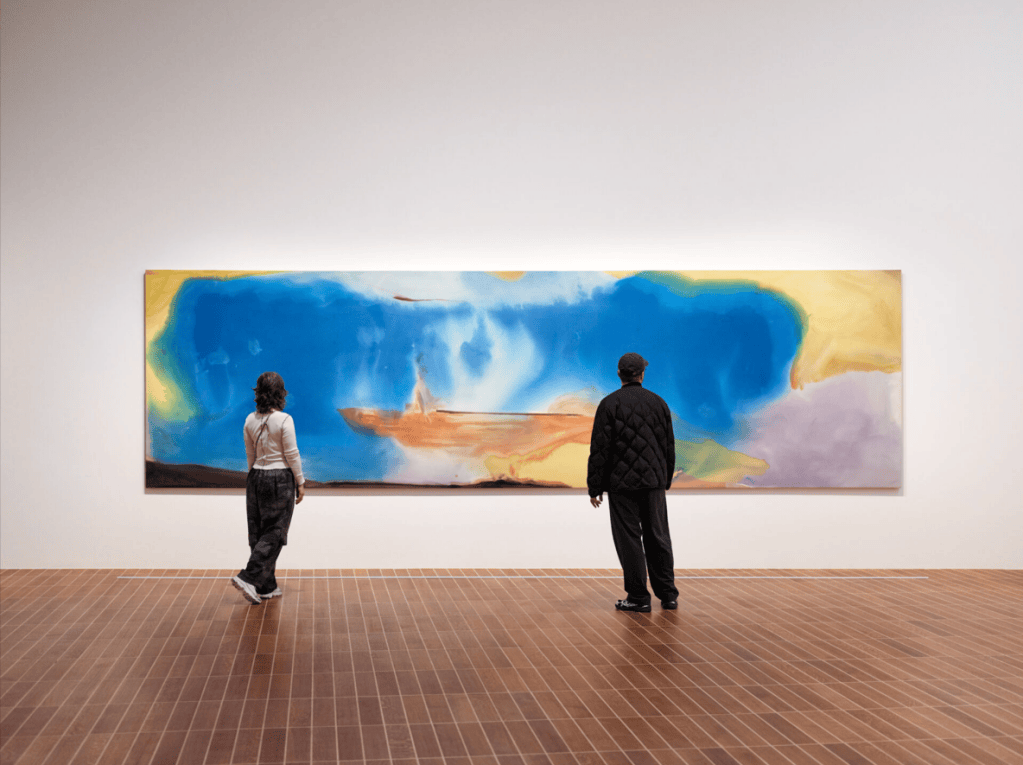
This spotlight arrives at a pivotal moment. As museums worldwide prepare for the centennial of Frankenthaler’s birth in 2028, Basel’s survey corrects a longstanding European oversight. Director Elena Filipovic notes that Frankenthaler’s influence permeates postwar abstraction, yet her central role has often been under-acknowledged. By placing her in conversation with both history and her male peers, the exhibition reshapes narratives long dominated by myths of masculine genius.
Frankenthaler’s story transcends privilege or personal connections. Her financial independence allowed bold risks at a time when women artists faced steep barriers. The result: a body of work that feels as fresh and vital today as it did when first poured onto the studio floor.
Visitors to Basel during Art Basel week will find the exhibition a perfect counterpoint to the fair’s contemporary buzz—a reminder that profound innovation often builds on centuries of looking, absorbing, and transforming.
Explore the full exhibition and plan your visit at the Kunstmuseum Basel official page. Learn more about the artist’s legacy through the Helen Frankenthaler Foundation. For deeper context on her European influences, read this insightful piece in The Art Newspaper. The beautifully illustrated catalogue, with essays by Haldemann and Karen Wilkin, is available in the museum shop.
Don’t miss this landmark survey while it remains in Basel. Secure tickets today and immerse yourself in one of postwar art’s most luminous achievements. Frankenthaler’s colors await—let them lead you.
The cover image in this article was AI-generated.