Blockchain Art’s Evolution: HEK and Tezos Collaboration
By Darren Smith, Arts Reporter
September 13, 2026
Museums spent years treating blockchain art as a side room: interesting, volatile, and hard to conserve. In Basel, that argument is being rewritten in public. The Tezos Foundation and HEK, the House of Electronic Arts, have spent 2026 running a year-long partnership built around three stubborn problems that digital culture still has not solved: how to exhibit work that lives on-chain, how to teach audiences what they are looking at, and how to keep those works alive after the marketplace cycle ends. A detailed account of the collaboration is available on Tezos Spotlight, which frames the program as institutional work rather than a marketing season.
The relationship did not begin this year. HEK publicly committed in 2022 to presenting, mediating, and collecting digital and media art, including blockchain and Web3 tools meant to widen participation and support sustainable on-chain collecting. The 2026 partnership takes that early statement and turns it into a calendar. Two exhibitions sit on HEK’s online platform, virtual.hek, while an outdoor presentation at the museum’s Basel site was timed to Art Basel 2026. Three guest curators, each working at the intersection of art and technology, were invited to treat the museum as something more porous than a white cube with a wifi password.
That structure matters because blockchain art often dies in translation. A token can prove provenance and still fail as a public experience. HEK’s answer has been to split the work across screens and streets. The virtual exhibitions were designed to feature at least six artists working with digital and blockchain-based practices, with companion releases on objkt, the Tezos-native marketplace that has become a primary venue for experimental on-chain work. The first virtual show, 404_LAND, opened June 12 and ran through August 9. Curated by Auronda Scalera and CuratorView, it treated the internet’s error page as a landscape: overlooked thresholds, broken links, unstable identity, and the territories that appear when a system refuses to resolve. Artists in the group included Gabriel Massan, dmstfctn, Varvara & Mar, Hind Al Saad, Kat Zhang, and Alida Sun.

During Art Basel week, the partnership moved outdoors. HEK and the Foundation presented Quayola: En plein air on the museum’s exterior platform, an installation that used computational vision to rework landscape tradition rather than merely project a token onto a wall. The gesture was practical as well as poetic. Fair week in Basel is crowded with collectors who still decide, in person, whether a digital practice belongs in a collection. Putting the work on the building asked those visitors to encounter blockchain art as civic material, not only as a listing.
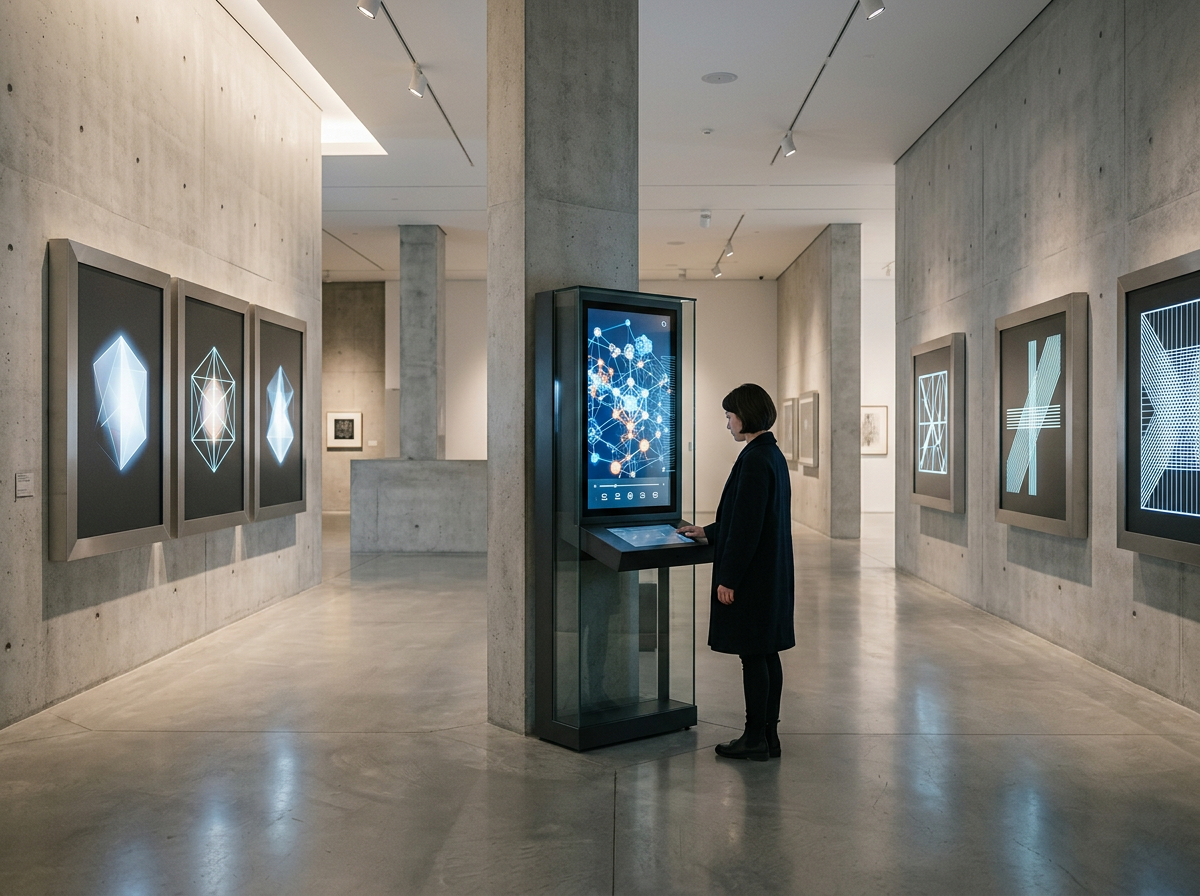
Inside the museum, HEK installed a kiosk so visitors could move from the physical galleries into the virtual program without treating the two as separate worlds. Workshops followed the same logic. Staff and invited educators used hands-on sessions to introduce blockchain, NFTs, and digital ownership to people who might never open a wallet on their own. The point was not to convert tourists into traders. It was to make the vocabulary of on-chain work as ordinary as the language of video art, which once looked equally foreign to museum boards.
Preservation is the part of the partnership that will outlast any single exhibition. HEK leads the working group Software-based Art and Ownership within the EU COST Action EMBARK, the European Media and Born-Digital Art Conservation and Knowledge Network. Through that role, the collaboration supports an international training school on NFT preservation hosted at ZKM | Center for Art and Media in Karlsruhe. Conservators, registrars, and curators from across Europe are being asked a blunt question: what does it mean to accession a work whose files, smart contracts, and display conditions can all drift? A token is not a painting. It is a set of dependencies. If museums want blockchain art in the collection rather than in a press release, they need shared methods for those dependencies.
HEK Director Sabine Himmelsbach has described the Tezos collaboration as a way to open curatorial and technological possibilities that a single institution cannot fund alone. Guest curators on virtual.hek, she has said, allow HEK to bring international perspectives into forms of media art that do not fit neatly inside a gallery plan. Aleksandra Artamonovskaja, Head of Art at Trilitech, the London research hub in the Tezos ecosystem, has called the model a “museum without walls.” In remarks reported by ARTnews, she stressed that growth in digital art is incomplete unless institutions also define what success looks like for artists, not only for volume.
That institutional patience is the Tezos pitch in 2026. The Foundation has spent years placing the Tezos stack inside museum programs with partners such as Musée d’Orsay, Serpentine, and LAS Foundation. Proof-of-stake, comparatively low energy use, and a culture of on-chain experimentation made the network attractive to artists who wanted contracts and community without treating every drop as a liquidity event. HEK gives that history a Swiss address at a moment when the wider NFT market is quieter, more selective, and more interested in whether a work can survive contact with a registrar.
The partnership will not settle every argument about digital ownership. It does something more useful. It treats blockchain as infrastructure for exhibition, education, and care, then tests that claim in a city that still sets the temperature of the global art trade. If the work holds, the next question is no longer whether museums should notice on-chain art. It is how many of them are prepared to keep it.
Follow HEK’s virtual program, visit the Basel kiosk when you are in town, and read the artists’ objkt releases before the next exhibition cycle closes. The most durable part of this story will be the works that remain accessible after the fair tents come down.