The Phillips Collection Opens Avery, Gottlieb & Rothko: By the Sea
By Darren Smith, Arts Reporter
October 24, 2026
The Phillips Collection opens Avery, Gottlieb & Rothko: By the Sea today in the museum Duncan Phillips built on 21st Street, bringing a Cape Ann friendship story into the house that already treats these three painters as family. The live exhibition page dates the Washington hang from October 24, 2026, to January 24, 2027, and says the show gathers approximately 90 paintings, drawings, and watercolors from the 1920s to the mid-1960s. An updated press release dated October 21 makes the larger claim: this is the first exhibition to examine in depth how friendship, artistic exchange, and shared summers on Cape Ann in Gloucester, Massachusetts, shaped Milton Avery (1885–1965), Adolph Gottlieb (1903–1974), and Mark Rothko (1903–1970).
What opens today — at a glance
- Title: Avery, Gottlieb & Rothko: By the Sea
- Venue: The Phillips Collection, 1600 21st Street NW, Washington, DC
- Dates: October 24, 2026–January 24, 2027
- Scale: Approximately 90 paintings, watercolors, drawings, and sketches
- Organizers: Cape Ann Museum, Gloucester, in partnership with The Phillips Collection
- Curators: Eliza Rathbone, guest curator; Renée Maurer, associate curator, coordinating the Washington presentation
- Originating hang: Cape Ann Museum, June 30–September 27, 2026
That Cape Ann first run is not a footnote. The museum’s own exhibition page calls this the first Cape Ann Museum–generated show to be taken on by another institution, and it says the organizers worked with all three artists’ estates. The Phillips, in the October 21 release, lists 16 lending museums for the Washington presentation, among them the National Gallery of Art, which is contributing ten works by Rothko, plus the Smithsonian American Art Museum, the Guggenheim, the Whitney, the Museum of Modern Art, the Brooklyn Museum, the Carnegie Museum of Art, the Museum of Fine Arts, Boston, the Wadsworth Atheneum, the RISD Museum, the Ackland Art Museum, Cornell’s Herbert F. Johnson Museum, the Virginia Museum of Fine Arts, Vassar’s Frances Lehman Loeb Art Center, the Cape Ann Museum, and the Phillips itself. Family collections are also in the mix. Many works, both institutions say, have never been on public view. Those are registrar sentences, not a critic’s estimate of rarity.
Key facts for readers and visitors
| Fact | Detail | Source basis |
|---|---|---|
| On view | Oct. 24, 2026–Jan. 24, 2027 | Phillips exhibition page / Oct. 21 press release |
| Address | 1600 21st Street NW, Washington, DC 20009 | Phillips footer |
| Hours | Tue–Sat 10 a.m.–5 p.m.; Sun 11 a.m.–5 p.m. (10–11 a.m. members only); closed Monday | Phillips visit page |
| Admission | Adults $20; seniors 62+ $15; students and educators $10; military $12; 18 and under free; members free | Phillips visit page |
| Works in Washington | Approximately 90 paintings, drawings, and watercolors | Phillips exhibition page |
| Lending museums | 16 named institutions, including 10 Rothkos from the National Gallery of Art | Phillips press release, updated Oct. 21, 2026 |
| Gloucester hang | June 30–September 27, 2026, Cape Ann Museum downtown campus | Cape Ann Museum exhibition page |
| Catalog | Rizzoli volume edited by Eliza Rathbone, with family and curator essays | Phillips press release; Cape Ann catalog note |
Hours and prices on the Phillips visit page are consistent enough to print this morning. Tuesday through Saturday the house is open 10 a.m. to 5 p.m. Sunday public hours begin at 11 a.m., with the 10-to-11 hour reserved for members, though the shop and café open to the public in that first hour. Monday is closed. General admission is $20 for adults, $15 for seniors 62 and older, $10 for students and educators with ID, and $12 for active-duty and retired military. Visitors 18 and under and members enter free. Advance reservations are encouraged; members check in without a reservation. On Third Thursdays the museum extends hours with free admission from 5 to 8 p.m. Those figures are the house’s published grid, not a travel desk rewrite. This article will not invent a special-exhibition surcharge the visit page does not print.
How the Phillips tells the friendship
- Meeting place: New York first, then Gloucester after Avery, the eldest, brought Gottlieb and Rothko north in the 1930s
- Shared ground: rocky coast, sandy beaches, and what Sally Michel Avery later called a chance to “live like an artist”
- Avery’s lane: harbor sketches and luminous coastal scenes that stay tied to the visible world
- Rothko’s lane: figurative compositions that give way to color-drenched canvases
- Gottlieb’s lane: beach-box motifs the museum names as the source of his later Pictographs
- House claim: a shared sense of place, an expressive use of color, and experiments with scale as catalysts for each mature style
The Phillips argument is not that the three men painted the same ocean. It is that a representational American modernist and two younger painters later identified with the New York School spent enough summers in the same light for an “undercurrent of aesthetic affinities” to survive into their iconic late work. Jonathan P. Binstock, the museum’s Vradenburg Director and CEO, puts the institutional stake in the October 21 release: the Phillips “has long been home to these three artists,” their work “woven into the DNA of this museum,” and the exhibition shows “how a shared sense of place and deep friendship gave rise to some of the most important art of the 20th century.” That is the director’s sentence. Readers should hear it as a house thesis, not as a newly discovered letter from Gloucester.
Renée Maurer, associate curator and coordinating curator in Washington, is more specific about what is new for visitors. “Exploring the friendship and shared experiences of Avery, Gottlieb, and Rothko during their summers on Cape Ann offers a fresh perspective on their artistic development,” she says in the same release. “This story will be new to many of our guests, and several of the works have never been on public view.” The Phillips also says the hang builds on recent technical research in its own conservation studio, where imaging and analysis were used to study materials and working methods. Patricia Favero, a Phillips conservator, is among the catalog contributors. Those are process claims the museum put on the record. This desk is not reprinting unpublished lab notes.
Why this museum can carry the story
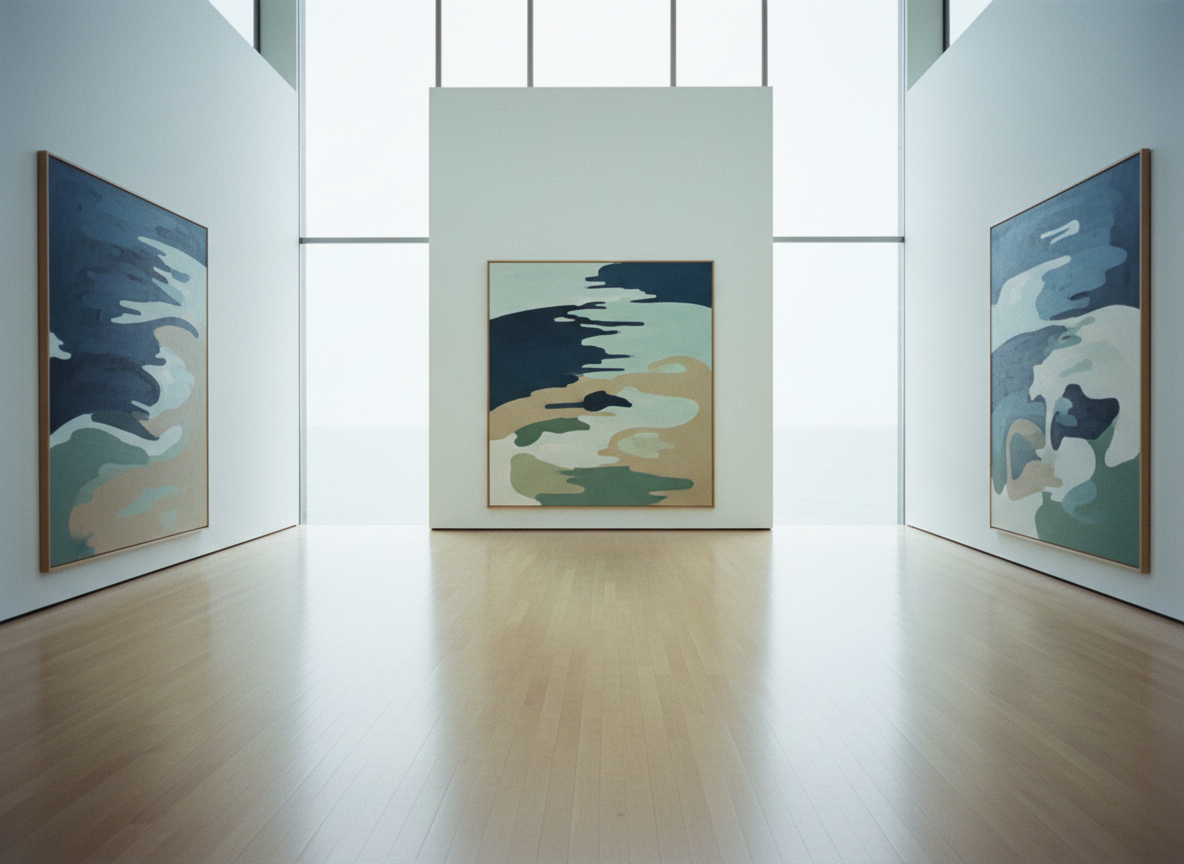
The press text’s provenance claim is unusually blunt for a friendship show. The Phillips says it was the first museum in the United States to acquire work by Avery, the first to establish a permanent gallery for Rothko’s paintings in 1960, and a long holder of significant Gottlieb pictures. The image the museum is circulating for the opening is Avery’s own Black Sea of 1959, oil on canvas, 50 by 67 3/4 inches, acquired by the Phillips in 1965 and still in the collection. That canvas is late Avery, not a 1930s Gloucester gouache, which is part of the point the curators are making: the coastal summers are being asked to explain mature work, not only early sketches. Cape Ann’s page reproduces a different Avery, Gorton’s Dock, about 1931–34, gouache on brown paper, from a private collection, as the originating-show banner. Two images, two chapters. The Washington public page now leads with the Phillips picture.
Eliza Rathbone, guest curator and the Phillips’s chief curator emerita, is the through-line between Gloucester and Dupont Circle. Cape Ann credits her with organizing the show “in collaboration with The Phillips Collection.” The catalog, published by Rizzoli and edited by Rathbone, is the other through-line. The Phillips release names essays by March Avery Cavanaugh, daughter of Milton and Sally Avery; Sean Cavanaugh, Avery’s grandson and director of the Milton & Sally Avery Arts Foundation; Sanford Hirsch, executive director of the Adolph and Esther Gottlieb Foundation; Dr. Christopher Rothko, Mark Rothko’s son and chair of the Rothko Chapel board; Kate Rothko Prizel, Rothko’s daughter; Martha Oaks, Cape Ann’s Henrietta Gates and Heaton Robertson Chief Curator; Dr. Adam Greenhalgh, associate curator at the National Gallery of Art; Maurer; and Favero. Cape Ann’s store copy adds that the volume includes more than 200 images and describes a 224-page book produced with Rizzoli Electa. Those page and image counts are Cape Ann’s. The Phillips release does not reprint them, and this article will not collapse the two catalog descriptions into one unverified specification sheet.
What the originating museum already established
- Cape Ann dates the friendship from the first shared summer in 1932 through the crystallization of ideas in the 1940s
- The Gloucester page describes “over 82” works and loans from 26 national and private institutional collections for that first hang
- The National Gallery’s ten Rothkos were already named as a central loan in Gloucester
- The Washington release now prints a tighter lender list of 16 museums for the Phillips presentation
- Both houses say many works have never been shown publicly
The two counts should be kept apart. “Over 82” and “26” collections are Cape Ann’s language for the Massachusetts hang that closed September 27. “Approximately 90” and “16 lending museums” are the Phillips’s language for what opens today. A loan list can grow, shrink, or be recategorized when a show travels; treating the Gloucester inventory as if it were the Dupont Circle checklist would be a false precision. What travels cleanly is the thesis: Avery, eighteen years older, drew from the visible world, while Gottlieb and Rothko later built nonrepresentational languages, and the three still formed what Cape Ann calls “a close-knit trio whose deep friendship and shared love of the ocean had a profound and lasting influence on their work.”
Support credits for the Washington presentation are also on the public record. Essential support is named to Martha R. Johnston and the Linda Lichtenberg Kaplan Exhibition Fund. Further support is listed from Chevy Chase Trust; Stephanie and Greg Guyett; Daniel W. Hamilton; Paul W. Killian and Carole Goodson; Alexi and Jeff Whitaker; and Barbara and Bob Hall, with the museum’s Exhibitions Endowment Fund. The exhibition and catalog received support from the Wyeth Foundation for American Art. The show is supported by an indemnity from the Federal Council on the Arts and the Humanities. Those names are the October 21 release’s donor block, not a society-page reconstruction.
Practical takeaways
- Today is the first public day in Washington, not a Gloucester leftover; the Cape Ann hang closed September 27
- Plan around Monday closure and the Sunday 11 a.m. public open
- Use the Phillips visit page for the $20 / $15 / $10 / $12 / free grid; do not assume a second special-ticket price
- Read the October 21 press release for the 16-museum lender list and the ten-Rothko National Gallery loan
- Treat Cape Ann’s “over 82” and the Phillips’s “approximately 90” as two institutional counts, not one number
- The catalog essays by the Avery, Gottlieb, and Rothko families are the house’s own invitation to hear the friendship from inside it
For ArtChain readers, the news peg is clean: a major American modern friendship show that already had a Gloucester summer now opens, on schedule, at the first museum of modern art in the United States, with a named guest curator, a coordinating curator on staff, a three-month run, and a lender list that includes ten Rothkos from the National Gallery. The verified address is 1600 21st Street NW. The verified close is January 24, 2027. Whether the Cape Ann light still reads on 21st Street, and whether visitors accept Binstock’s claim that the affinities survived into the late work, is a question for the next ninety days in the house that already owned Black Sea. The first Saturday is today.