Minimalism Recalibrated: Anne Truitt’s First European Retrospective Brings Poetic Depth to Düsseldorf’s K20
DÜSSELDORF, Germany — March 30, 2026 — In a long-overdue acknowledgment of one of Minimalism’s most influential yet underrecognized figures, the Kunstsammlung Nordrhein-Westfalen has opened “Anne Truitt: Pioneer of Minimal Art,” the American artist and writer’s first comprehensive European retrospective. On view at the K20 museum through Aug. 2, the exhibition assembles roughly 120 works spanning more than four decades of Truitt’s career, from her groundbreaking columnar sculptures of the early 1960s to the luminous works on paper and stark late-series paintings that defined her later years.

The sleek, glass-fronted K20 building on Grabbeplatz now houses Truitt’s quietly monumental forms, inviting viewers to reconsider Minimalism not as cold geometry but as something deeply personal, sensuous, and memory-laden.
Born in 1921 in Baltimore and trained initially as a psychologist before turning to art in her 30s, Anne Truitt (1921–2004) translated the flat language of painting into freestanding wooden sculptures she hand-painted with meticulous layers of color. “I wanted color set free into three dimensions,” she once wrote, a statement that now echoes through the galleries. Her tall, plank-like columns—often monochromatic or subtly banded—evoke the verticality of the human body and the landscapes of her Maryland childhood, blending the rigor of Minimal Art with an emotional undercurrent her male contemporaries rarely pursued.

A black-and-white portrait captures Truitt in her studio, ladder at her side, paint-splattered smock over a collared shirt—practical, focused, the image of an artist who worked methodically and largely outside the spotlight of New York’s 1960s art scene.
The exhibition, organized by the Kunstsammlung Nordrhein-Westfalen in collaboration with the Musée de Grenoble and Madrid’s Museo Nacional Centro de Arte Reina Sofía, traces Truitt’s evolution with scholarly precision. Early sculptures like those from her landmark 1960s series stand alongside the radical white-on-white Arundel paintings and the deep-black Piths she completed near the end of her life. Works on paper reveal her lifelong fascination with color as both structure and sensation.

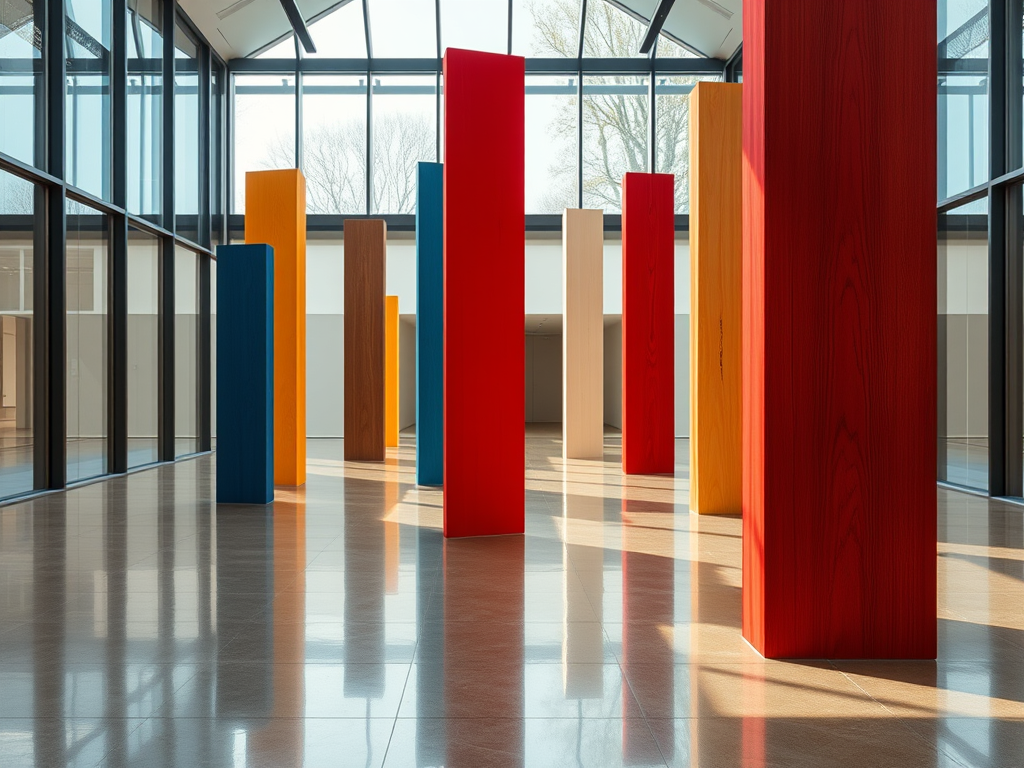
In one sweeping gallery, a forest of painted wooden columns in saturated reds, blues, creams, and browns rises from low platforms, their reflections gleaming on polished floors—a quiet dialogue of form and hue that feels both architectural and intimate.
Another space pairs a towering black monolith with a low blue bench-like form and a large abstract painting whose sweeping color bands recall Truitt’s own descriptions of color as “memory made visible.”
Curators have framed the show as a recalibration of Minimal Art’s canon. For decades Truitt was overshadowed by figures like Donald Judd and Carl Andre, despite her pioneering role in moving painting’s concerns into sculpture. This exhibition positions her work as profoundly embodied—paint applied by hand, forms rooted in personal experience—offering European audiences a fuller picture of an artist who was also a prolific diarist and memoirist.

A low, undulating green-and-cream sculpture anchors a corner, flanked by framed works on paper and a vibrant, multi-hued painting—evidence of Truitt’s range beyond the austere reputation that long preceded her in Europe.
Support for the project came from the Terra Foundation for American Art and the Ernst von Siemens Kunststiftung, underscoring its international significance. The show will travel to Grenoble and Madrid after Düsseldorf, ensuring Truitt’s legacy reaches wider audiences.
Visitors wandering the light-filled K20 galleries—some pausing before a single column bathed in natural light—may sense what Truitt herself described as the “affect” of color and form. In an era when museums worldwide are re-examining historical omissions, this retrospective feels both timely and timeless: a quiet triumph for an artist who never shouted but whose work continues to resonate.
Tickets are available via the Kunstsammlung’s website. For those unable to travel to the Rhine, the exhibition’s accompanying catalogue promises to extend the conversation long after August.


