Liu Wei’s Speculation Opens on The Met’s Fifth Avenue Facade
By Darren Smith, Arts Reporter
September 17, 2026
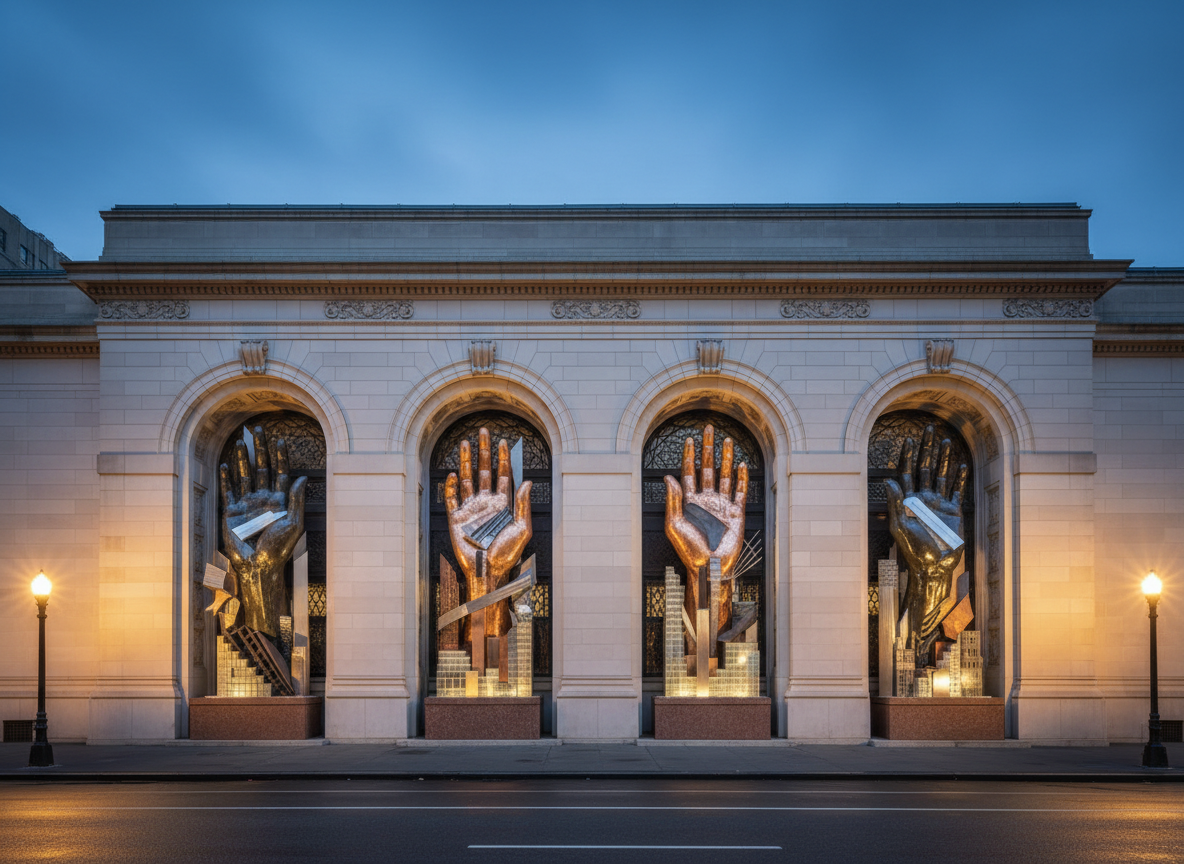
New York’s Metropolitan Museum of Art opened The Genesis Facade Commission: Liu Wei, Speculation today on its Fifth Avenue exterior, placing four new site-specific sculptures into the museum’s Beaux-Arts niches through June 8, 2027. The installation is Liu’s first major presentation in the United States and, according to reporting tied to the museum’s announcement, the Met’s first commissioned work by an artist from China since 2006. For visitors walking up the museum steps this week, the commission is not a temporary banner or a lobby takeover. It is the building’s front door speaking in a contemporary sculptural dialect.
The project continues the Met’s annual Genesis Facade Commission series, launched as a multi-year partnership that builds on contemporary facade commissions dating back to 2019. Liu’s turn is the seventh in that contemporary sequence. The Beijing-based artist, born in 1972 and trained in oil painting at the China Academy of Art in Hangzhou (BFA, 1996), is known for large-scale installations that treat urbanization, fragmentation, and social contradiction as raw material. Speculation brings that method outdoors, where tourism, traffic, and weather become part of the viewing condition.
What opens today — at a glance
- Title: Speculation (The Genesis Facade Commission: Liu Wei)
- Venue: The Metropolitan Museum of Art, Fifth Avenue facade niches, New York
- Dates: September 17, 2026–June 8, 2027
- Scale: Four monumental, site-specific sculptures
- Curator: Lesley Ma, Ming Chu Hsu and Daniel Xu Curator, Department of Modern and Contemporary Art
- Significance: Liu’s first major U.S. museum presentation; seventh contemporary Met facade commission
Museum director Max Hollein framed the selection around Liu’s mix of curiosity, invention, and humor, tying the commission to the spirit of the Met’s forthcoming Oscar L. Tang and H.M. Agnes Hsu-Tang Wing for modern and contemporary art, designed by Frida Escobedo and scheduled to open in 2030. In Hollein’s words, the facade project expands what the iconic Fifth Avenue elevation can do while introducing Liu’s practice to an American institution at full outdoor scale. The Tang Wing itself is a longer horizon: more than 70,000 square feet planned for the display of art, plus outdoor terraces, inside a broader reimagining of how the Met shows work from 1890 to the present.
Liu has described the sculptures as “a pile of still life objects brusquely sutured together.” That phrase matters. It signals assemblage rather than polished monumentality, and it matches curator Lesley Ma’s emphasis on reconfiguration: works that pierce habitual perceptions of reality with a blend of rawness and refinement. The sculptures are meant to unsettle the classical niches rather than sit politely inside them. Two taller works flank the main entrance; the outer pair are more delicate in scale. Across all four, a recurring motif is the human hand—a form dense with art-historical associations and, in Liu’s reading, a bridge between the recognizable and the fantastical.
Key facts for readers and visitors
| Fact | Detail | Source basis |
|---|---|---|
| On view | Sept. 17, 2026–June 8, 2027 | Met exhibition listing / Genesis newsroom |
| Works | Four facade-niche sculptures | Met / FAD Magazine report on announcement |
| Series position | Seventh contemporary facade commission | FAD Magazine citing Met lineage |
| Prior artists in series | Wangechi Mutu, Carol Bove, Hew Locke, Nairy Baghramian, Lee Bul, Jeffrey Gibson | FAD Magazine |
| U.S. milestone | Liu’s first major U.S. presentation | Met exhibition text / FAD |
| China commission note | Met’s first commissioned work by an artist from China since 2006 | FAD Magazine |
| Artist base | Lives and works in Beijing | Met / FAD artist bio |
| Training | BFA, oil painting, China Academy of Art, Hangzhou, 1996 | FAD Magazine artist bio |
Those dates and credits have been consistent across institutional and secondary reporting since the August 2026 announcement cycle. Genesis, the automotive brand partner on the commission, publicly confirmed the September 17, 2026–June 8, 2027 window when Liu was named, and the Met’s exhibition page restates the same span for visitors planning a trip. Design coverage published for the opening day likewise lists the run through early June 2027. In other words, today’s opening is not a soft preview with soft dates; it is the public start of a nine-month outdoor run.
How Speculation is built to be read
- Assemblage logic: organic and geometric forms, mixed textures, finishes, and colors
- Urban memory: fragments drawn from contemporary city life and historical architecture
- Bodily motif: the hand as connector between everyday recognition and speculative form
- Social pressure: rupture, repair, and renewal framed against rapid change in globalizing China
- Architectural friction: sculptures that refuse to “fit” the classical niche as decoration
David Breslin, Leonard A. Lauder Curator in Charge of Modern and Contemporary Art, has said the Genesis Facade Commission lets the Met continually rethink how it introduces itself to each visitor and to the world. Liu’s remixes of readymade motifs, Breslin argued, turn everyday forms toward the miraculous—an interplay of contemplation, surprise, and revelation that is also “the very business of The Met.” That language is institutional, but it is useful: the facade is not a side gallery. It is the museum’s most visible contemporary platform until the Tang Wing opens later this decade.
Liu’s own comments strike a different register. “To dialogue with the tremendous legacy of human civilization through The Met’s Genesis Facade Commission makes me so excited and anxious,” he said. “What a challenge and a blessing.” The anxiety is not ornamental. Outdoor commissions on a landmark facade must survive weather, crowd photography, and the compression of meaning that comes with being seen from a taxi window. They also inherit the ethics of public address: who is welcomed by a museum threshold, and who is asked only to look from the sidewalk.
Where Liu’s practice comes from
Since the late 1990s, Liu has worked across photography, painting, video, sculpture, and installation. He belongs to a generation of Chinese artists who pressed for conceptual vocabularies on their own terms amid rapid social transformation. Solo museum presentations over the past decade in Beijing, Shanghai, Seoul, and Cleveland form the immediate runway into New York. Group exhibitions cited in the Met’s announcement materials include the inaugural China Pavilion at the 51st Venice Biennale (2005); the Shanghai Biennial (2004, 2010); the Lyon Biennale (2007, 2015); Sharjah Biennial (2013); Art and China after 1989: Theater of the World at the Guggenheim Museum, New York, and SFMOMA (2018); The Allure of Matter: Material Art from China at LACMA (2019); and the 58th Venice Biennale (2019).
- Medium range: photography, painting, video, sculpture, installation
- Recurring concerns: urbanization, material contradiction, scale, and the readymade
- Institutional arc: major Asian and European biennials before this U.S. outdoor debut
- New York context: first major U.S. presentation arriving via the Met’s most public wall
That résumé matters because facade commissions can flatten an artist into a single photo opportunity. Liu’s strength has been refusing a single mood or a single material honesty. The hand motif in Speculation is not a soft humanism sticker on hard architecture; it is a hinge. Hands make, repair, point, refuse, and accumulate labor. Placing that motif against Beaux-Arts stone on Fifth Avenue asks whether encyclopedic museums can still metabolize contemporary global practice without turning it into seasonal décor.
Readers tracking the Met’s contemporary program should also keep the Tang Wing timeline in view. Escobedo’s wing—described by the museum as the first designed by a woman in the Met’s 155-year history—is set for 2030 and is repeatedly invoked by Met leadership as the indoor destination toward which these outdoor commissions point. Until then, Genesis Facade works carry an outsized share of the museum’s contemporary public address. Liu’s nine-month run therefore functions as both an exhibition and a bridging statement: contemporary art at the Met is already on the sidewalk, not waiting politely for a new wing.
Practical takeaways
- Plan for an outdoor viewing experience; the works occupy exterior niches, not indoor galleries
- Expect a long run—into early June 2027—rather than a short festival install
- Use the commission as context for the Met’s broader modern/contemporary rebuild toward 2030
- Read primary materials on the Met’s exhibition page and the August 2026 announcement cycle for credits and quotes
- Treat secondary reports (including FAD Magazine’s detailed announcement recap) as corroboration, not a substitute for the museum’s own listing when dates or access change
For ArtChain readers, today’s opening is the clean news peg: a major Chinese contemporary sculptor takes the Met’s most public stage on schedule, with a titled suite of works, a named curator, a fixed end date, and an institutional frame that connects Fifth Avenue’s niches to a 2030 wing still under construction. Go see the sculptures in changing light. Then decide whether Speculation reads as rupture, repair, or both at once—the question Liu has been asking, in different materials, for more than two decades.