Beeple’s Viral Robot Dog Installation in SF
By Darren Smith, Arts Reporter
April 10, 2026
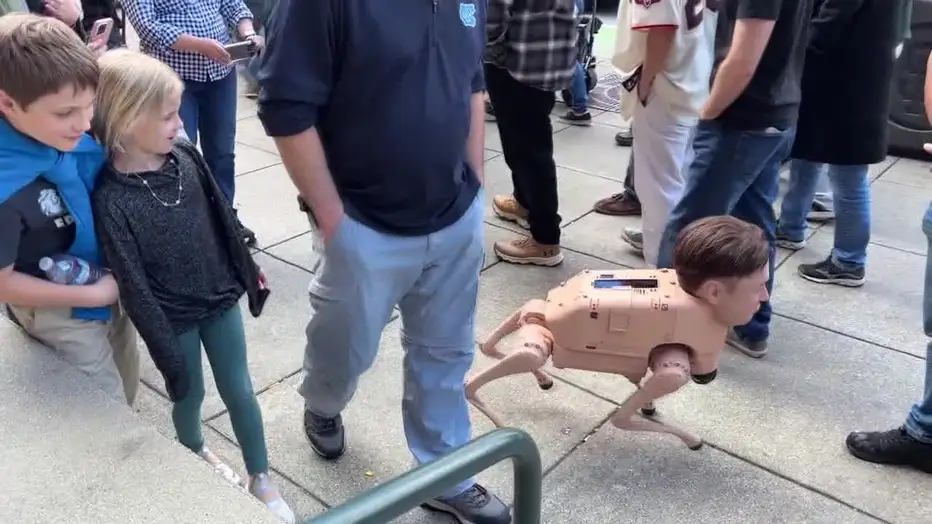
An Elon Musk-headed robot dog roamed the streets near Oracle Park and South Park in San Francisco on April 8, drawing stares, videos, and occasional interactions from pedestrians and baseball fans. The machine, part of Mike Winkelmann’s (Beeple) Regular Animals (2025), uses a Unitree Go2 chassis fitted with a hyper-realistic silicone mask produced by Hyperflesh. The walk served as street-level promotion for Beeple’s mid-career survey BEEPLE: / INFINITE_LOOP, scheduled to open April 18 at NODE Foundation in Palo Alto.
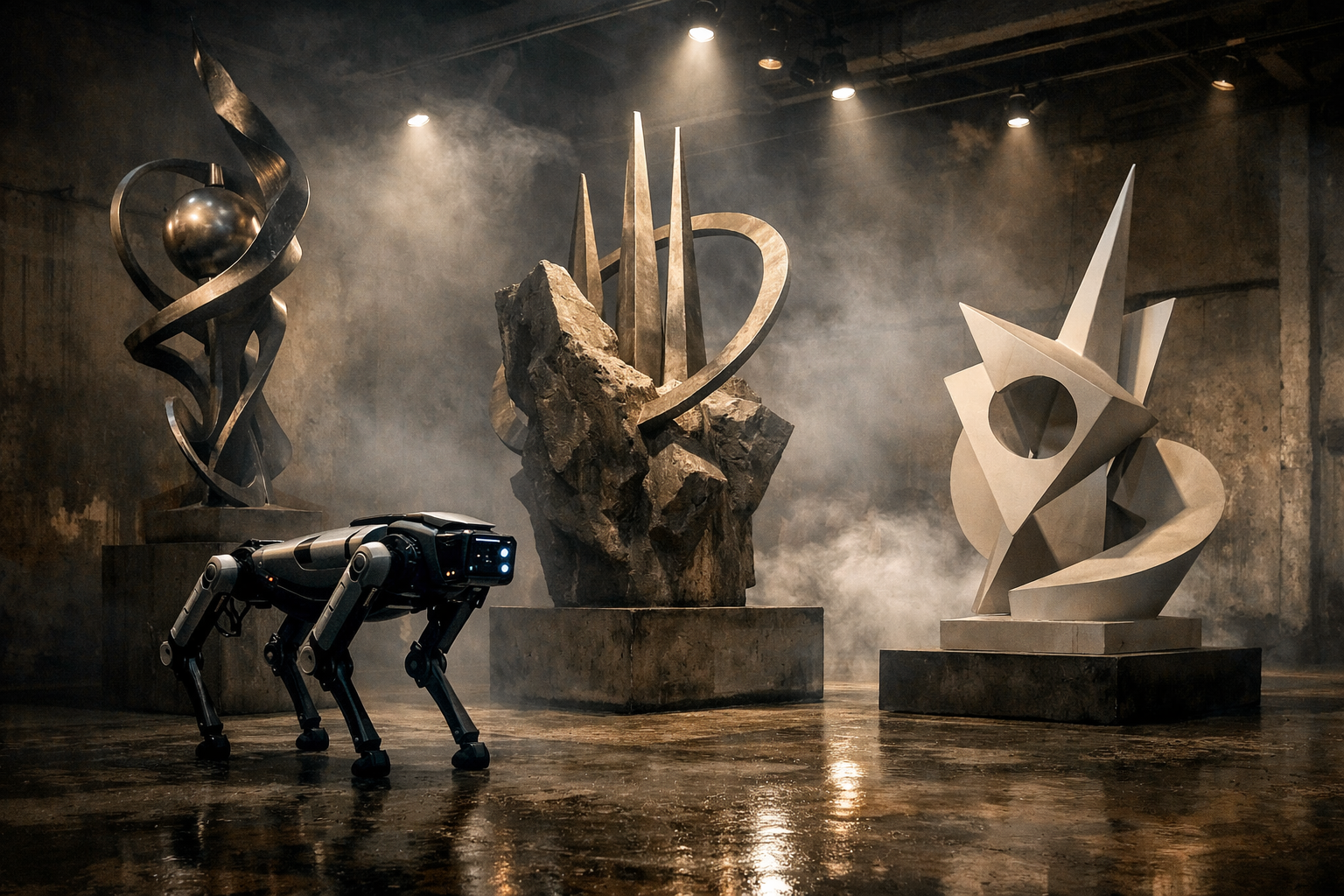
Regular Animals debuted at Art Basel Miami Beach in December 2025 in the fair’s inaugural Zero 10 digital art section. The installation placed semi-autonomous robot dogs—equipped with heads resembling Elon Musk, Mark Zuckerberg, Jeff Bezos, Pablo Picasso, Andy Warhol, and Beeple himself—inside a transparent pen. The units photographed crowds via onboard cameras and periodically entered “poop mode,” ejecting printed images or certificates styled after each figure. Reports indicate all pieces sold during the VIP preview for approximately $100,000 each.
The San Francisco deployment recycled the spectacle for direct public visibility ahead of the Palo Alto opening. NODE described the action as extending the work’s energy beyond the gallery. Videos spread quickly on social platforms, delivering targeted exposure with minimal conventional advertising costs.

This approach reveals ongoing challenges in Beeple’s trajectory and the digital art sector. Winkelmann gained global attention with the $69.3 million Christie’s sale of Everydays: The First 5000 Days in 2021. By 2026, NFT trading volumes have dropped more than 90% from 2021 peaks. The Art Basel/UBS Global Art Market Report 2026 records overall market growth of 4% to $59.6 billion in 2025, driven by high-end physical sales and a rebound in public auctions. Online-only sales fell to $9.2 billion, the lowest since 2019. While 51% of surveyed high-net-worth collectors purchased digital art in 2024–2025 and its share in collections rose to 13%, secondary market liquidity for many headline NFTs, including Beeple’s flagship work, has contracted sharply.
The Musk robot dog leverages recognizable likeness and technical execution for immediate impact, yet its satire on tech power and surveillance remains largely gestural. The “pooping” mechanism, once positioned as dystopian commentary, now doubles as engineered virality that capitalizes on the same attention dynamics it appears to critique.
A curator with experience in new media installations, speaking anonymously due to professional ties in the field, noted: “Beeple consistently treats spectacle as an integral medium. Translating the work from screen and fair booth to physical robotics and public streets compels direct engagement with the uncanny presence of robotics and AI in daily environments. The theatrical element lands effectively.”
Marcus Hale, an independent collector and analyst focused on post-2021 digital asset performance, offered a more critical assessment: “This functions primarily as marketing packaged as satire. The robots achieved quick sales at the fair through novelty and name association. Sustained institutional depth and resale liquidity remain unproven when the central device prioritizes crowd engagement over layered conceptual or material inquiry. Comparable hype-driven projects have lost momentum once initial novelty subsided.”
Key gaps persist. While Regular Animals has lined up additional exposure, including a spring 2026 presentation at Berlin’s Neue Nationalgalerie during Gallery Weekend, the work’s interrogation of AI companionship, data capture, or concentrated power stays at the level of visual pun. The Palo Alto timing aligns with Silicon Valley networks, where patronage and pointed commentary frequently intersect without deep friction. Primary beneficiaries appear to be Beeple (renewed visibility and potential primary placement), NODE (increased attention in a competitive space), and the robots themselves as mobile promotional tools.
The project raises unanswered questions around likeness rights for living public figures and the resource demands of robotics fabrication, though these receive limited scrutiny amid the viral cycle. In the 2026 market environment—marked by selective recovery favoring tangible substance over repeatable digital or mechanical gimmicks—the stunt illustrates a familiar pattern: sustained attention through provocation, with translation to enduring critical or commercial weight still pending.
The April 18 NODE survey will test whether street-level spectacle and fair novelty can anchor a broader mid-career assessment or whether the work remains tethered to episodic viral moments in a sector that has recalibrated away from 2021-era exuberance.
Darren Smith is an Arts Reporter at Art Chain News covering contemporary art, digital art and NFTs, body art, and the intersections between these fields.
This article is based on direct examination of materials, market data, background interviews, and independent analysis.