The New Museum’s Triumphant Reopening: A Bold New Chapter for Contemporary Art in New York
New York, March 19, 2026 — After more than three years of construction and a decade of visionary planning, the New Museum has reopened its doors today, March 21, marking one of the most significant institutional milestones in recent contemporary art history. The $82 million expansion, designed by Pritzker Prize-winning architects OMA (led by Shohei Shigematsu and Rem Koolhaas) in collaboration with executive architect Cooper Robertson, doubles the museum’s footprint to approximately 120,000 square feet, seamlessly integrating with the iconic 2007 SANAA-designed flagship building on the Bowery.
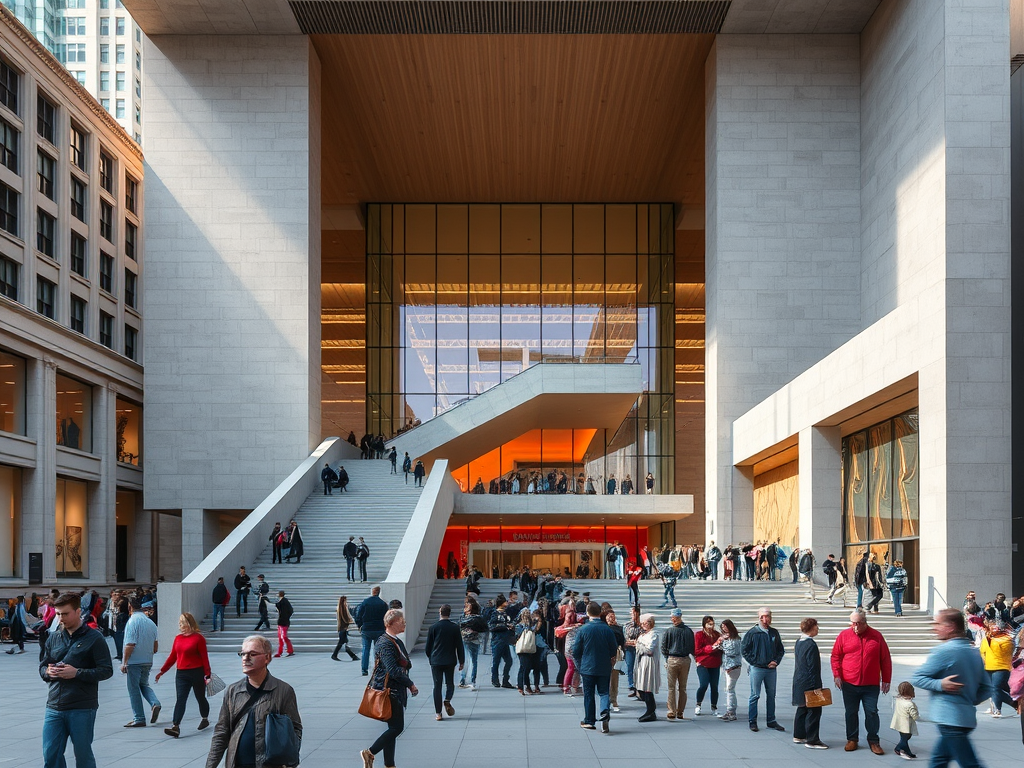
This transformation cements the New Museum’s position as Manhattan’s sole institution dedicated exclusively to contemporary art, now equipped with expanded galleries, enhanced public programming spaces, a new 74-seat Forum theater, an enlarged Sky Room on the seventh floor, and improved circulation via three new elevators and a dramatic Atrium Stair. The redesign rethinks the museum’s relationship to the street, introducing an entrance plaza that invites greater community engagement and accessibility.
The reopening coincides with the launch of the ambitious inaugural exhibition, New Humans: Memories of the Future. Spanning the entire expanded museum, the show features works by over 200 artists, writers, scientists, and thinkers, exploring the profound ways technology—particularly artificial intelligence—has reshaped human identity, memory, and existence. Highlights include site-specific commissions that will remain on long-term view: Tschabalala Self’s facade artwork Art Lovers, Klára Hosnedlová’s intervention on the Atrium Stair, and Sarah Lucas’s plaza sculpture VENUS VICTORIA (opening in spring 2026). The exhibition weaves together historical and contemporary perspectives, from Salvador Dalí to emerging voices like Precious Okoyomon, prompting urgent questions about humanity in an era of rapid technological change.
Free admission during the opening weekend of March 21–22 drew enthusiastic crowds, with registration made possible through generous support from New Museum Trustee Charlotte Feng Ford. Visitors explored not only the new galleries but also a reconfigured building that prioritizes fluid movement, inclusivity, and public interaction—hallmarks of the institution’s mission since its founding in 1977.
This reopening arrives amid a broader wave of institutional growth in 2026. In Los Angeles, the Los Angeles County Museum of Art (LACMA) prepares to unveil its $720 million David Geffen Galleries in April, featuring 2,500–3,000 works reorganized thematically rather than chronologically. The Lucas Museum of Narrative Art, housing George Lucas’s vast collection of illustration, animation, and film artifacts, is slated for a September debut. Globally, anticipation builds for the Guggenheim Abu Dhabi (nearing completion on Saadiyat Island) and other projects like V&A East in London and expansions at Crystal Bridges Museum of American Art.
The New Museum’s expansion, however, stands out for its focus on the present and future of art. As director Lisa Phillips noted in recent statements, the project reflects a commitment to “risk-taking, experimentation, and relevance” in an evolving cultural landscape. With its bold architectural statement and forward-looking programming, the revitalized New Museum not only redefines its own identity but also signals a renewed vitality for contemporary art institutions worldwide.
As visitors step into the expanded spaces, they encounter a museum that has grown not just in size, but in ambition—ready to engage new generations with the complex realities of our time. For those unable to attend the opening weekend, the museum now welcomes the public during regular hours, with tickets available via its website.
This is more than a reopening; it is a declaration that contemporary art remains essential, adaptive, and urgently alive.