The Middle East Emerges as the Global Art Market’s Defining Force in 2026
In the shimmering heat of the Gulf, where desert sands meet architectural ambition, the art world is undergoing its most profound geographic realignment in decades. What was once dubbed an “emerging” market has, almost overnight, asserted itself as a central axis of global cultural power. According to ArtTactic’s Global Art Market Outlook 2026, a staggering 76% of industry experts predict growth in the Middle East and North Africa (MENA) region this year—the highest confidence level anywhere on the planet—far outpacing the global average of 51%.
This surge is no fleeting boom fueled by oil wealth alone. It represents the culmination of more than a decade of deliberate, state-backed investment in cultural infrastructure, now bearing fruit in a cascade of landmark openings, fair expansions, and institutional partnerships that are redrawing the map of contemporary collecting.
The year began with a historic milestone: the inaugural Art Basel Qatar in Doha in February, transforming the Qatari capital into a temporary epicenter of the international art scene. Held in the creative enclave of Msheireb and the Doha Design District, the fair brought together top global galleries in an exhibition-style format, complete with thought-provoking talks and a focus on regional voices. Insiders described it as “groundbreaking,” signaling that the Gulf is no longer merely hosting events—it is shaping them.
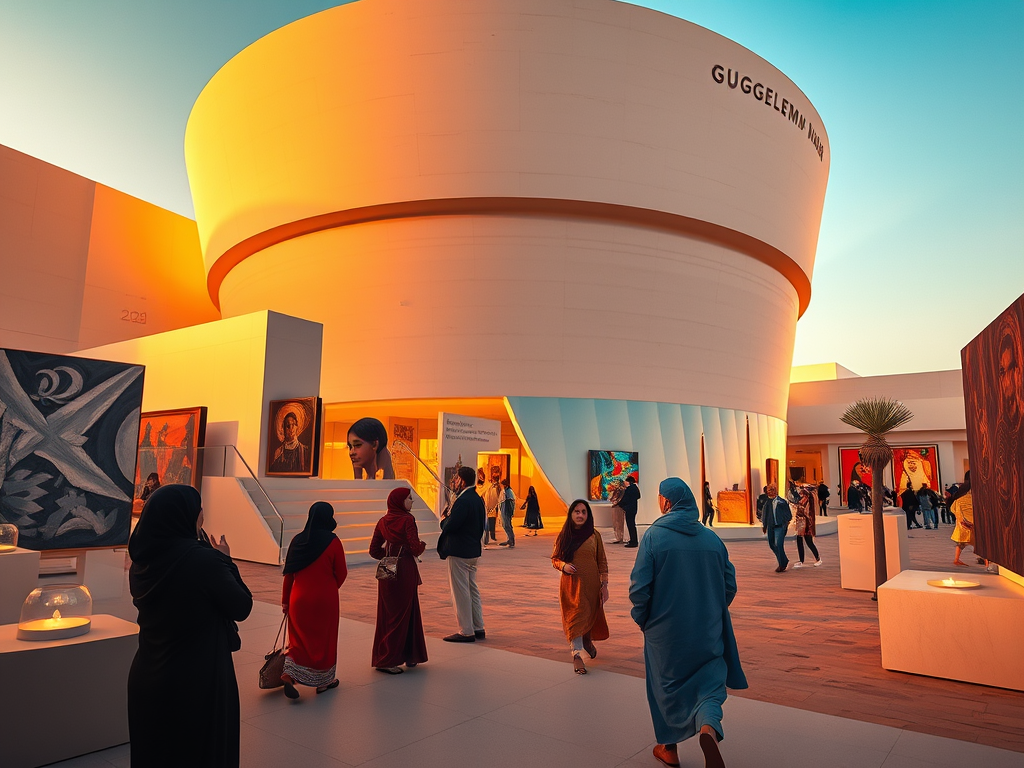
Abu Dhabi follows closely, with the long-awaited opening of the Guggenheim Abu Dhabi, designed by the late Frank Gehry, set to become the foundation’s largest outpost worldwide. Anchored on Saadiyat Island alongside the already-iconic Louvre Abu Dhabi, the museum promises a sweeping focus on post-1960s art, with special emphasis on West Asian, North African, and South Asian practices. Its arrival, alongside recent launches like the Zayed National Museum and teamLab Phenomena, solidifies the emirate as a permanent crossroads for modern and contemporary art.
Further momentum comes from Frieze Abu Dhabi, slated for November, building on the emirate’s strategic investments—including ADQ’s $1 billion stake in Sotheby’s in 2024—and Qatar’s sustained cultural patronage under figures like Sheikha Al Mayassa bint Hamad bin Khalifa Al Thani. Saudi Arabia, too, continues its ascent with the third Diriyah Contemporary Art Biennale and the fifth AlUla Arts Festival, drawing international crowds to site-specific works and heritage-infused programming.
Auction houses have taken note. Sotheby’s posted strong results from its early forays into Saudi Arabia, while Christie’s reported a 73% jump in MENA-related sales in recent years, reaching record highs. Total auction sales for MENA artists climbed 9.4% to $33.2 million in 2025, with women artists from the region gaining accelerating recognition. Galleries, facing softer demand in traditional Western hubs, are increasingly turning to the Gulf, where public investment in museums, biennials, and tourism continues unabated—projected regional economic growth of around 3.9% in 2026 provides a stable backdrop amid global volatility.
Yet this ascent is not without shadows. Escalating geopolitical tensions in the broader Middle East have raised concerns about travel disruptions, shipping delays, and the long-term stability of ambitious plans. Some observers worry that external conflicts could temper the influx of international collectors and dealers, particularly as events like Art Dubai approach in April. Still, the art market has proven resilient, often moving “in a different gear than the news,” as one advisor put it.
What sets the Gulf apart is the depth of its ecosystem: not just wealth, but museums, education initiatives, artist residencies, and government vision that extend far beyond short-term spectacle. As one Saudi gallerist observed, pioneers took risks years ago; now followers arrive to a maturing landscape.
In 2026, the debate is no longer whether the Middle East is “emerging.” It has emerged—confident, institutional, and increasingly indispensable. The global art market, once centered firmly in New York, London, and Hong Kong, is rebalancing toward new horizons. And for the moment, those horizons shimmer brightest over the dunes of the Gulf.