The Smell of Earth Opens at the Minnesota Museum of American Art
By Darren Smith, Arts Reporter
October 22, 2026
The Minnesota Museum of American Art opened The Smell of Earth: Seitu K. Jones Working in the Elements to the public today in downtown St. Paul, giving the city’s best-known civic artist a museum hang that the institution itself calls the first major solo museum exhibition of his work. The live exhibition page dates the show from October 22, 2026, to July 25, 2027, and places it across the Nancy and John Lindahl Gallery and the Sally and Ernest Lehmann Family Gallery. For a Thursday opening at a museum that is already closed Monday through Wednesday, the peg is local and overdue at once: a St. Paul practice built in parks, farms, light-rail stations, and half-mile tables is being asked to stand as studio art, archive, and Midwestern landscape painting without leaving the neighborhood that made it.
What opens today — at a glance
- Title: The Smell of Earth: Seitu K. Jones Working in the Elements
- Artist: Seitu K. Jones (also Seitu Ken Jones), St. Paul multidisciplinary artist, gardener, and archivist
- Venue: Minnesota Museum of American Art, 350 Robert Street North, St. Paul, MN 55101, Historic Pioneer Endicott
- Galleries: Nancy and John Lindahl Gallery and Sally and Ernest Lehmann Family Gallery
- Dates: October 22, 2026–July 25, 2027
- Claim: first major solo museum exhibition of Jones’s work, per the museum
- Opening reception: Thursday, October 29, 6–8 p.m., free
The exhibition listing is the cleanest public record. It says Jones describes his practice as “tending the soil of community,” a phrase his studio biography has used for years, and it identifies him as a master gardener, food-justice advocate, historian, and archivist. The museum’s own count of his outdoor career is over 40 large-scale public art projects in the Twin Cities. That number is newer and larger than the “more than thirty” large-scale works printed when the McKnight Foundation named him Distinguished Artist in 2017. This desk is not averaging the two sentences. Readers should treat “over 40” as the 2026 museum’s figure for the career now on view, and “more than thirty” as the foundation’s 2017 wording. Both are official. Neither is a wall checklist of this hang.
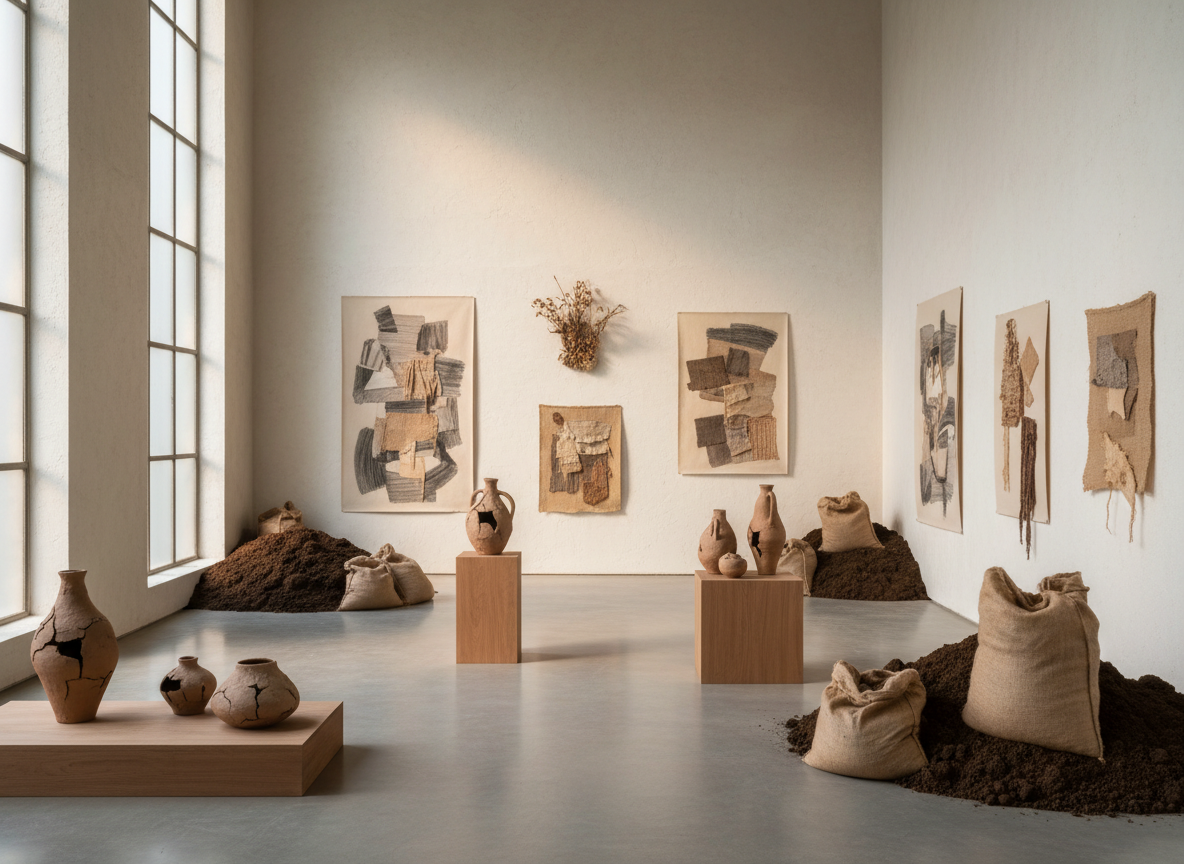
The curators, Ego Ahaiwe Sowinski and Alexandra Nicome, wrote the sentence that explains why a public artist is being shown through charcoal, pigment, and clay. “Sifting through loose earth, artist Seitu Jones finds all the material he needs to sustain his artistic practice,” they say on the exhibition page. “Perhaps best known for his environmentally focused public art and advocacy in the space of food justice, his studio practice takes a simpler approach to Earth’s matter. Jones explores the relationship between Midwestern landscapes and his body, family history, and distant ancestors through charcoal, pigment, and clay.” The Smell of Earth, they add, gathers work from across the practice “with a focus on the subject and material that most consistently captures his attention: the land and its creative bounty.” Those are the museum’s nouns, not a critic’s inventory.
Key facts for readers and visitors
| Fact | Detail | Source basis |
|---|---|---|
| On view | Oct. 22, 2026–July 25, 2027, Lindahl and Lehmann galleries | MMAA exhibition page |
| Address | 350 Robert Street North, St. Paul, MN 55101, Pioneer Endicott | Exhibition page; visit page |
| Gallery hours | Thursday–Sunday, 10 a.m.–5 p.m.; closed Monday–Wednesday | MMAA hours page |
| Admission | Free; no ticket required | Visit page; Visit Saint Paul listing |
| Opening reception | Oct. 29, 6–8 p.m.; free | MMAA event page |
| Public-art count | Over 40 (2026 museum); more than 30 (2017 McKnight) | Both official; counts differ by year |
| Transit | Metro Green Line, Central Station, one block | Visit page |
| Closest ramp | Jackson Street Ramp, 345 Jackson Street | Visit page |
| Front desk | 651.797.2571 | Exhibition and visit footers |
Hours and prices are consistent on the pages that matter for a morning visitor. The hours and directions page lists Thursday through Sunday from 10 a.m. to 5 p.m. and does not post Monday, Tuesday, or Wednesday hours. Admission is free. Visit Saint Paul’s calendar listing for the same exhibition repeats both facts and the Robert Street address. The museum has no designated lot. Meter parking is most reliable on Kellogg Boulevard, one block away. From the Jackson Street Ramp, visitors are told to take the elevator to skyway level 3A and follow signage. The Green Line stop is named as Central Station. Those are the museum’s logistics, not a tourism rewrite.
A later reception is already on the clock and should not be confused with today’s public opening. The museum’s event listing sets a free opening reception for October 29, 6:00 p.m. to 8:00 p.m. at the same address. Today is the first general day the galleries are open with the show installed. Next Thursday is the party. The current-exhibitions index also prints an “October 13, 2025” stamp above the Jones listing. That looks like a page-publish date, not a second run of dates. The exhibition page and the reception page both keep the 2026–2027 span. This article follows those two pages.
How the museum says the show is built
- Thesis: studio work and archive, not a greatest-hits tour of outdoor monuments
- Materials named: charcoal, pigment, and clay, plus objects and ephemera from Jones’s archive
- Curators: Ego Ahaiwe Sowinski and Alexandra Nicome, working with Jones on the selection
- Method: the curators say they situate the practice through medium, connecting content and process
- Public backdrop: Community Meal events and more than 40 outdoor projects remain the career the museum is reframing
Jones’s studio page is useful as named biography, not as a substitute for a registrar’s checklist. It says he has been “tending the soil of community through art for more than 40 years,” holds a B.S. in landscape design and an M.L.S. in environmental history from the University of Minnesota, is a recently retired faculty member of Goddard College, and lives in St. Paul with the poet Soyini Guyton. Selected commissions on that page include Turnip Greens at the Nashville Farmers Market in 2019; At the Crossroads: A Community Meal at Newfields in Indianapolis the same year; Shadows at the Crossroads at the Minneapolis Sculpture Garden in 2019, a collaboration with Ta-coumba T. Aiken and Guyton; the Rice Street, Dale Street, and Lexington Parkway light-rail stations in St. Paul in 2014; the Storyteller’s Bench at the Rondo Community Outreach Library in 2013; and a corten Harriet Tubman for the Tubman Center Alliance in Minneapolis in 2003. Those titles are Jones’s own selected list. The museum does not say which of them, if any, appear as objects in The Smell of Earth.
The civic work the museum is turning away from, in order to look at the studio, still needs its dates. Jones’s studio and the Joyce Foundation both describe CREATE: The Community Meal as a 2014 project that seated 2,000 people at a table a half-mile long on Victoria Street in Frogtown, produced with Public Art Saint Paul. Joyce dates the dinner to September 14, 2014, and says it followed a year of listening with support from a Joyce Award. The studio later took versions of the meal to Grand Rapids, where it received the Grand Juried Prize at ArtPrize 9 in 2017, and to Indianapolis in 2019. In 2013 Jones co-founded Frogtown Farm, a five-acre urban farm in a St. Paul city park. The McKnight Foundation’s 2017 Distinguished Artist citation, a $50,000 honor then in its twentieth year, added that he was the first artist-in-residence for the City of Minneapolis, an original company member of Penumbra Theatre, a founder of Urban Boatbuilders, and a board member of the Capitol Region Watershed District. Kate Wolford, then McKnight’s president, said his designs had been “built into the foundation of Minneapolis’s Nicollet Mall and St. Paul’s Green Line transit system.” Those sentences are the foundation’s, from 2017. They explain why a free museum in the Pioneer Endicott can call this a milestone without inventing a new public-art census.
What the museum will not let a morning article do is pretend the galleries are a map of those outdoor sites. The exhibition page is explicit that The Smell of Earth is “a deep exploration of his less-examined studio work, shown alongside objects and ephemera from his extensive archive documenting his experience as a Black artist in Minnesota.” Drawings, paintings, sculptures, and design are the categories named. African American culture, symbolism, history, and ancestral knowledge are the subjects named. Jones, the museum says, worked closely with Ahaiwe Sowinski and Nicome to choose the work. A visitor who wants the half-mile table will not find it reconstructed as a dining room. The land is present as material. The archive is present as evidence. The public monuments stay in the city that already has them.
Practical takeaways
- Today is the first public day; the free reception is next Thursday, October 29, 6–8 p.m.
- The museum is open only Thursday–Sunday, 10 a.m.–5 p.m.; do not plan a Monday visit
- Admission is free; Visit Saint Paul repeats that no ticket is required
- Use 350 Robert Street North, not a skyway guess, as the public entrance from transit or street parking
- Personal photography is allowed; flash, tripods, selfie sticks, posed commercial pictures, and photography of loaned objects are not
- Courtesy wheelchairs, ear plugs, noise-canceling headphones, and fidgets are listed at the welcome desk
- Holiday closures already posted: New Year’s Day, Independence Day, Easter, Thanksgiving, Christmas Eve, Christmas Day
The visit page’s photography and access rules are worth keeping attached to a free opening, because they are the museum’s, not atmosphere. Personal photography is allowed. Posed or commercial photography is not. Objects on loan, marked on labels, may not be photographed. Flash, tripods, selfie sticks, and lighting equipment are prohibited. Access notes include courtesy wheelchairs at the welcome desk, ASL interpretation by request to access@mmaa.org, MERV13 filtration, two decompression spaces, and an open-plan building the museum itself says can be loud, with construction noise in downtown St. Paul. Those sentences do not make the Jones show a community-center program. They describe the house that is showing it.
For ArtChain readers, today’s opening is the news, not a preview of a reception that is still a week away. The indoor exhibition is now public. The hours are posted. The curators have named the materials. The museum has called the hang a first. Jones’s outdoor career — the farm, the rail stations, the 2014 table — is the documented reason the studio work is being asked to carry a nine-month run. Whether those charcoal and clay pieces read as a late-career survey or as a new argument about land as both subject and medium is a question for the Lindahl and Lehmann galleries, not for a morning wire. The verified run is through July 25, 2027. The first public Thursday is today. After that, the earth stays on Robert Street until midsummer.