Rediscovered Painting ‘Bob’ by Elizabeth Murray to Return to Museum
By Darren Smith, Arts Reporter
August 2, 2026
A painting by the late American artist Elizabeth Murray that vanished from public view for more than four decades has resurfaced in remarkable condition and will soon return to exhibition, marking a significant rediscovery in postwar American art. The 1977 work titled Bob, long believed lost or inaccessible even to scholars, is scheduled to make its museum debut this fall at Duke University’s Nasher Museum of Art, following a meticulous restoration that has restored its vibrant presence.
Murray, who died in 2007 at the age of 66, is widely regarded as one of the most inventive painters of her generation. Known for pushing the boundaries of the canvas with irregular shapes, bold colors, and a playful yet rigorous blend of abstraction and everyday motifs, she drew inspiration from cartoons, Cubism, Surrealism, and Abstract Expressionism. Bob occupies a crucial place in that trajectory. Created as an homage to her friend and fellow artist Robert Moskowitz, the painting features uneven sides oriented in a diamond format, along with signature elements such as an enlarged comma-like shape and a painter’s palette. Nasher Museum chief curator Marshall Price has emphasized its importance, observing that it captures Murray at a transitional moment just before she fully embraced the shaped canvases that defined her mature style. “It is a major work by Murray from a period that was so crucial to her development,” Price explained. “It preceded the shaped canvases that she’s probably best known for, but Bob also has the hallmarks of a post-minimal language she was developing in the mid and late 1970s.”
The painting’s near disappearance began shortly after its first public appearance. It was exhibited at Paula Cooper Gallery in New York in 1978 and soon purchased by Burroughs Welcome Pharmaceutical Company. Installed at the company’s Research Triangle Park headquarters in North Carolina, Bob remained there for over 45 years, largely unknown outside the building. When the structure was demolished because of asbestos contamination, the canvas was recovered by United Therapeutics, the firm that had assumed the campus. In 2021 the company donated the work to the Nasher Museum. By that point it showed significant damage, including cracking that resulted from Murray’s characteristic method of applying wet paint over still-wet layers.
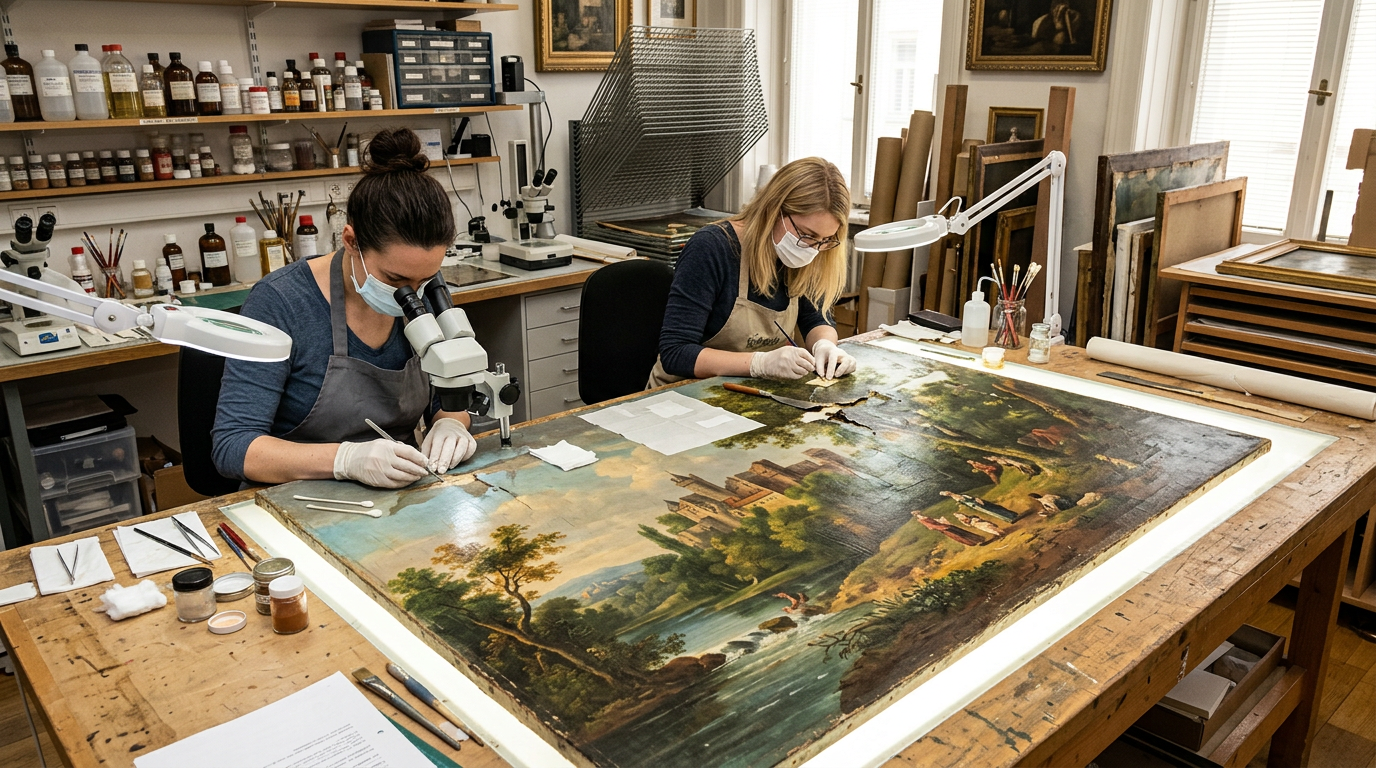
Conservation efforts, largely underwritten by a $100,000 grant from Bank of America and conducted in consultation with the Elizabeth Murray Foundation, spanned more than a year. Specialists installed a new stretcher and applied carefully calibrated treatments to stabilize the surface. Price has described the outcome as rescuing the painting “from the dustbin of history,” noting that it had been out of sight for so long that its return constitutes a genuine second life for the work.

The timing of the rediscovery could hardly be more opportune. Murray has been the subject of growing institutional and commercial attention in recent years. The Museum of Modern Art presented a focused exhibition of her work earlier in 2026, while David Kordansky Gallery in Los Angeles mounted a pairing of her paintings with ceramics by Betty Woodman. Curator Mia Matthias, who organized the MoMA show, has spoken of a “well-deserved new wave of interest” that builds on longstanding admiration for the artist. Dealer David Kordansky has linked the renewed focus to a wider effort to acknowledge women artists who expanded the possibilities of their mediums without always receiving full critical recognition during their lifetimes.
Market indicators also reflect rising engagement. Murray’s auction record of $437,500 was set at Sotheby’s New York in 2019 for the 2001 painting Little Fingers, which exceeded its high estimate by a substantial margin. While many of her works still trade in the lower thousands, the trajectory suggests expanding recognition. Works from the same period, such as Children Meeting (1978) in the collection of the Whitney Museum of American Art, already illustrate the post-minimal exuberance Murray brought to abstraction. Bob stands out, however, for revealing an artist willing to challenge the very structure of the picture plane itself.
When the Nasher places the restored painting on view this fall, it will mark what experts believe is the first time Bob has been presented in a museum setting. The institution is also preparing a short documentary chronicling the work’s rediscovery and conservation, ensuring the story reaches audiences beyond those who visit the galleries. For scholars, the painting supplies a missing link in understanding how Murray moved from relatively conventional formats toward the dynamic, multi-panel constructions of her later career. For the broader public, it offers a chance to encounter the artist’s restless energy at a formative stage—when humor, formal invention, and emotional directness were already fully present.
In an art world increasingly attentive to works that have slipped from the historical record, the return of Bob serves as a quiet triumph of stewardship and persistence. What might have been permanently lost to industrial demolition and decades of neglect has instead been carefully brought back into the light. Murray once insisted that form itself could carry expressive power; this rediscovered canvas now stands as vivid confirmation of that belief, ready to speak to new viewers with the same vitality that first distinguished it nearly half a century ago.
Plan a visit to the Nasher Museum of Art this fall to see Bob in person, and deepen your understanding of Elizabeth Murray’s pioneering contributions by reading the full account of its recovery on Artnet News.
The cover image in this article was AI-generated.


