Chase Hall: Coffee Stains and Contemporary Art
By Darren Smith, Arts Reporter – April 27, 2026
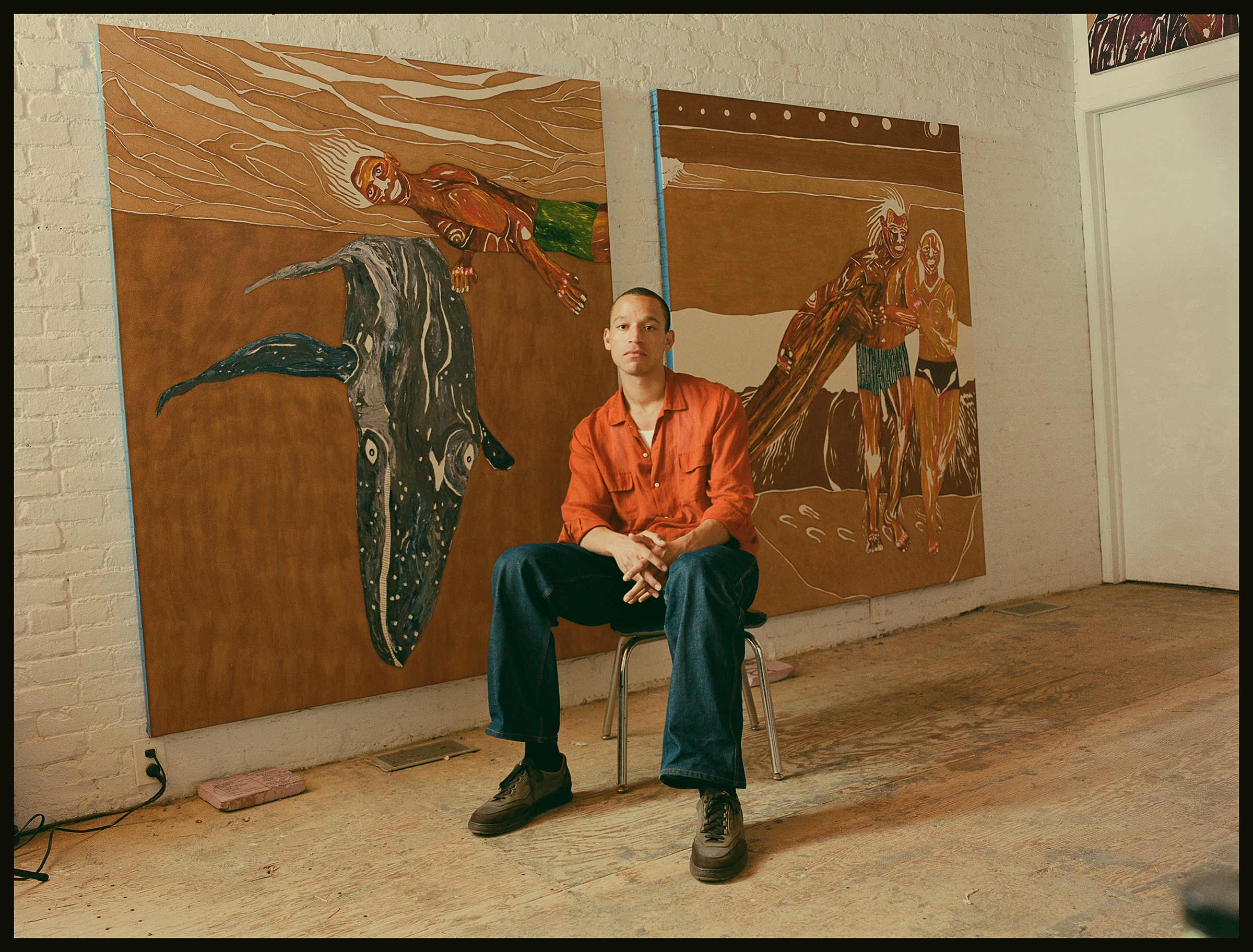
In the sunlit loft of a former industrial building in upstate New York, Chase Hall stands before a towering canvas, a mug of strong black coffee in one hand and a brush in the other. The aromatic liquid—once a simple beverage—has become his signature medium, staining raw cotton with deep, unpredictable hues that evoke both nourishment and the bitter legacies of labor and exploitation. At just 33, Hall has emerged as one of the most compelling voices in contemporary American art, a self-taught painter whose work interrogates race, family, memory, and the enduring shadows of history.
Hall’s rise from itinerant childhood to institutional darling exemplifies the dynamism of today’s art world, where personal narrative and material innovation collide to create resonant, urgent statements. His paintings, often monumental in scale, blend figurative precision with conceptual depth, using coffee stains on unprimed cotton to explore biracial identity and the American experiment. As museums and collectors vie for his pieces, Hall remains grounded in the stories that shaped him—and those he now shapes for his own young family.
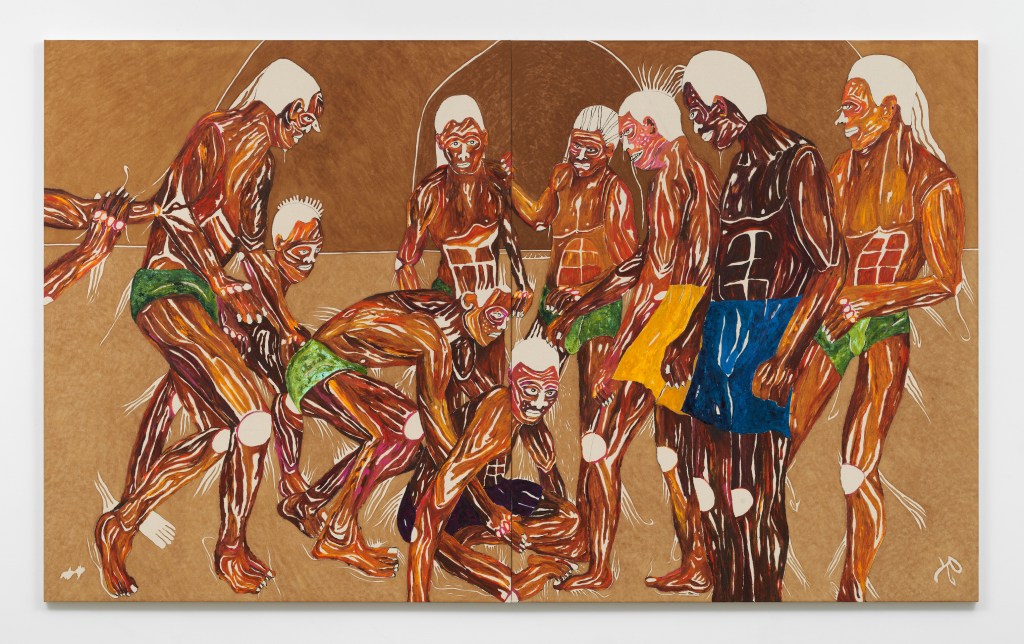
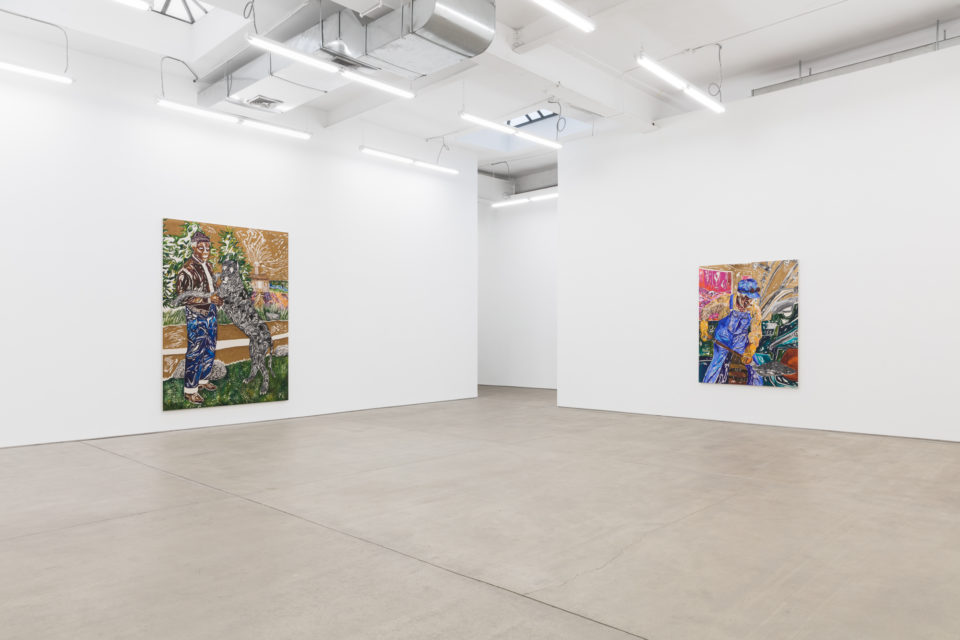
A Great Day in Harlem, 2020
acrylic and coffee on cotton canvas
60 x 48 inches
(152.4 x 121.9 cm)
Born in 1993 in St. Paul, Minnesota, to a Black father and white mother, Hall’s early life was marked by movement and complexity. Raised primarily by his single mother—a woman he affectionately calls a “hustler gangster lady”—the family relocated across Chicago, Las Vegas, Dubai, Colorado, and Los Angeles. In high school, one of the few Black students, Hall gravitated toward debate and history classes rather than traditional art electives, though he dabbled in photography and ceramics.
“My mom was always a single parent,” Hall has reflected. “She was never married.” This fractured family dynamic, coupled with the absence of his father, would later fuel much of his artistic inquiry into belonging, inheritance, and the “gray areas” of identity.
Moving to New York around a decade ago with ambitions in photojournalism, Hall found himself drawn instead to the tactile possibilities of paint. Entirely self-taught, he began experimenting with coffee as a pigment around 2018. The choice was both practical—coffee was cheap and abundant in his studio—and profoundly symbolic. Coffee connects to global trade routes, colonial histories, and the labor of enslaved and marginalized people, while cotton canvas recalls the plantations of the American South. “I use these materials to question America’s past and present,” Hall explains, “while interrogating the realities of being biracial.” Read more about his process.
Hall’s breakthrough came swiftly. His first significant New York solo exhibition, Aleczander at CLEARING gallery in Brooklyn in 2021, drew immediate institutional attention. Works from that show were acquired by the Whitney Museum of American Art, the Walker Art Center, the Hammer Museum, and the Los Angeles County Museum of Art (LACMA). By 2022, he had joined powerhouse galleries David Kordansky in Los Angeles and New York and Galerie Eva Presenhuber in Europe.
That same year, the Metropolitan Opera commissioned Hall for a monumental diptych, Medea Act I & II, installed in its opera house—a rare honor for such a young artist. In 2023, his first institutional solo exhibition, The Close of Day, opened at the SCAD Museum of Art in Savannah, Georgia, solidifying his reputation.
Hall’s technique is meticulous yet alchemical. He applies coffee in layers, allowing it to bloom and bleed into the cotton fibers, creating gradients that mimic skin tones, shadows, and emotional states. Figures emerge—often Black bodies in moments of leisure, labor, sport, or introspection—against stark white grounds that evoke both purity and erasure. The resulting works feel alive, as if the history embedded in the materials is actively participating in the image-making.
Themes of fatherhood, inheritance, and hybridity run throughout. In recent series, Hall grapples with becoming a father himself, examining how societal forces shape even the most intimate bonds. His 2025 exhibition Momma’s Baby, Daddy’s Maybe at Galerie Eva Presenhuber in Vienna delved into these territories with works like The Talented Tenth (Mixed Doubles) and Mama Tried, featuring young figures navigating punk aesthetics, sports, and domestic scenes.
“Becoming a parent has prompted me to consider more carefully the ties that bind communities and families,” Hall noted in a recent interview. The exhibition marked a maturation, shifting from reflections on his own childhood to the legacies he will pass on.
Hall’s material investigations extend beyond canvas. He incorporates bricks, barricades, and sculptural elements that reference redlining, gentrification, and physical barriers in American cities. His multidisciplinary practice also includes photography, video, and audio works, though painting remains central.
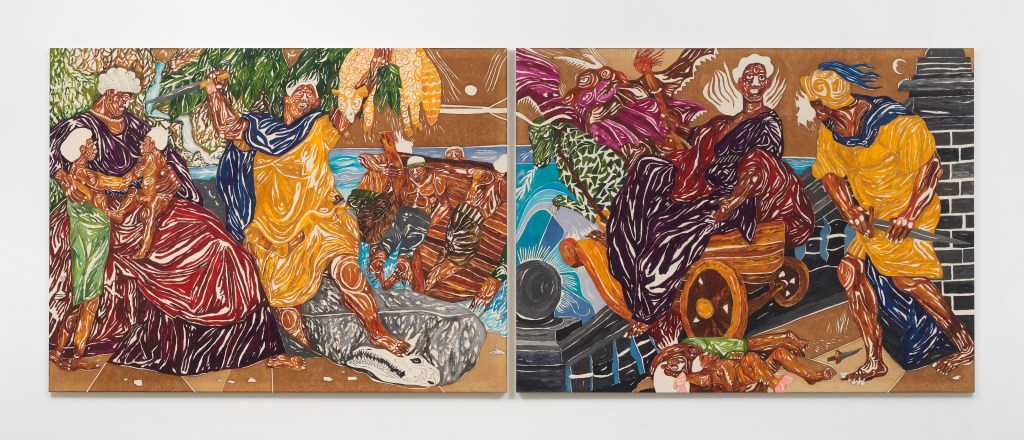
Medea, Act I & II (Feuerbach & Van Loo), 2022
acrylic and coffee on cotton canvas
diptych, overall:
81 x 216 inches
(205.7 x 548.6 cm
Critics praise Hall for avoiding didacticism while refusing neutrality. His figures occupy ambiguous spaces—celebratory yet haunted, powerful yet vulnerable. As one reviewer observed, Hall “hits at the heart of race and fatherhood,” using personal history to illuminate broader societal fractures.
Institutional validation has followed commercial success. Hall’s work resides in prestigious collections including the Metropolitan Museum of Art, Brooklyn Museum, Dallas Museum of Art, Fondation Louis Vuitton, Baltimore Museum of Art, High Museum of Art, Montreal Museum of Fine Arts, SFMOMA, and The Studio Museum in Harlem. He has participated in major group shows such as the NGV Triennial in Melbourne, Black American Portraits at LACMA, and Get in the Game: Sports, Art, Culture at SFMOMA.
Residencies at Skowhegan School of Painting and Sculpture (2019), MASS MoCA (2020), and others provided crucial space for experimentation during his ascent. In 2021, he earned a spot on Forbes 30 Under 30, and auction records have climbed steadily, with pieces fetching six figures.

The Furnace of Adversity, 2021
acrylic and coffee on cotton canvas
72 x 60 inches
(182.9 x 152.4 cm)
Yet Hall resists the label of “rising star” as mere hype. “I’m interested in the ever-shifting lines between personal and generational narratives,” he states on his gallery page. His practice is deliberate, rooted in research and lived experience rather than market trends. Explore his full biography.
In an era when figurative painting has resurged, Hall stands out for his conceptual rigor and material specificity. Coffee, once dismissed as gimmick, has proven a rich metaphor—its staining power mirroring how history indelibly marks bodies and psyches. Cotton, meanwhile, forces confrontation with America’s original sin of chattel slavery and its economic foundations.
Hall’s work resonates particularly with younger audiences and collectors seeking art that addresses identity without reducing it to slogan. His biracial perspective offers nuance in discussions often polarized by binary thinking. As he explores “Halfrican” identity—his term for the hybrid experience—viewers find mirrors for their own complex selves.
Recent profiles in Vogue, GQ, Harper’s Bazaar, and Artnet have amplified his visibility, positioning him as a defining talent of the 2020s. His 2025 show in Vienna traveled American archetypes abroad, inviting international dialogue on U.S. racial dynamics.
Looking ahead, Hall continues to push boundaries. Upcoming projects hint at deeper explorations of sports as cultural metaphor, new print editions, and possibly larger sculptural installations. With a new generation of collectors and institutions prioritizing diverse voices, his trajectory seems poised for even greater impact.
What sets Hall apart is not just technical innovation or timely themes, but an authentic voice forged through dislocation and discovery. In staining canvases with coffee, he stains collective memory with truth—messy, layered, and profoundly human.
As debates about representation and history continue to animate American culture, artists like Chase Hall remind us that painting can be both mirror and map, reflecting where we’ve been while charting paths forward.
Discover Chase Hall’s work firsthand by visiting David Kordansky Gallery or Galerie Eva Presenhuber. Explore his studio practice and latest news at his official site, follow his journey on Instagram @hallchase, and support emerging voices by attending exhibitions or engaging with collections at institutions like the Studio Museum in Harlem. The conversation about identity and history is ongoing—add your perspective by experiencing the art that shapes it.
Darren Smith is an arts journalist, practicing artist, and tattooist with 26+ years of experience across traditional, digital, and body art practices. He covers the intersections of craft, culture, and collecting for ArtChain News.