Banksy Unmasked: Reuters Investigation Identifies Street Artist as Robin Gunningham
London, United Kingdom — A year-long investigative report by Reuters has presented compelling evidence identifying the pseudonymous street artist Banksy as Robin Gunningham, a Bristol-born man in his early 50s, potentially ending one of the art world’s longest-running mysteries.
Published March 13, 2026, under the title “In Search of Banksy,” the special report—authored by Simon Gardner, James Pearson, and Blake Morrison—traces the artist’s path from a war-damaged village in Ukraine to London streets and New York court archives. The journalists uncovered previously undisclosed U.S. police and court records from a 2000 arrest in Manhattan, where a man was charged with disorderly conduct for defacing a billboard. A handwritten confession in those files, signed “Robin Gunningham,” combined with matching biographical details, timelines, witness accounts, and cross-referenced records, leads Reuters to conclude the identity “beyond dispute.”

Sources indicate Gunningham legally changed his name to David Jones around 2008—one of Britain’s most common male names—to evade scrutiny after earlier speculation, including a 2008 Mail on Sunday exposé naming him. The report notes that anonymity has fueled Banksy‘s brand, enabling politically charged works critiquing war, capitalism, and authority while commanding multimillion-dollar values at auction.
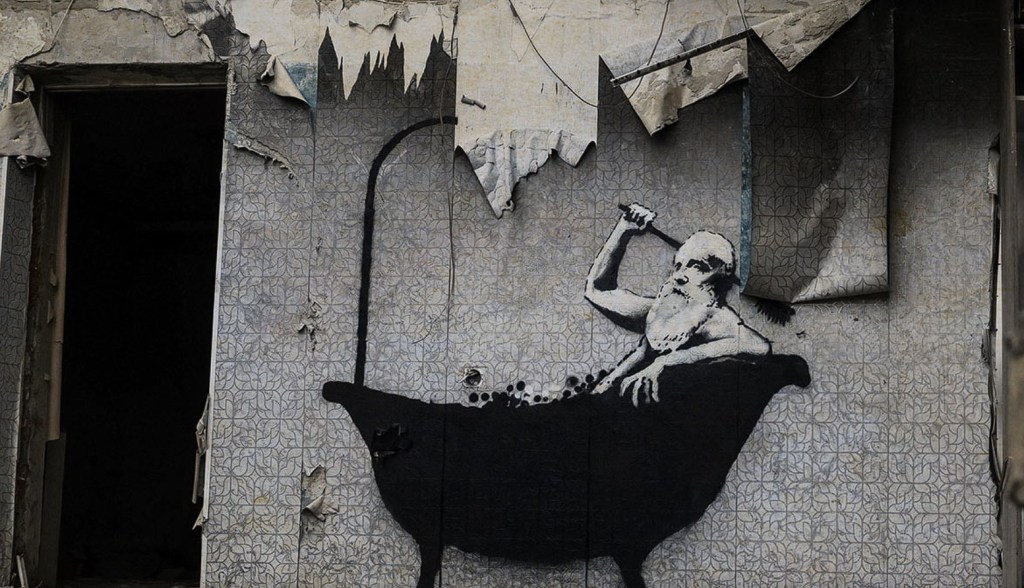
The investigation began with a 2022 Banksy mural in Horenka, Ukraine—a man in a bathtub scrubbing his back, stenciled on a bombed-out building amid Russia’s invasion. Reporters interviewed locals, reviewed immigration records, and connected the dots: Robert “3D” Del Naja of Massive Attack was in Ukraine at the time, but evidence places Gunningham (under his new name) as the central figure. Del Naja may have collaborated on execution or stencils, but the core identity traces to Gunningham.

Pest Control, Banksy‘s official authentication body, has not commented substantively, stating only that the artist “has decided to say nothing.” Banksy‘s longtime lawyer, Mark Stephens, has indicated the artist disputes certain details in the report but has not directly confirmed or denied the identification.
The revelation has ignited debate in the art community. Some argue unmasking erodes the mystique that amplifies Banksy‘s anti-establishment message, while others view it as affirming his work’s power—created by an “ordinary” individual who operated in shadows. Iconic pieces like the self-shredding “Girl with Balloon” (2018) and Ukraine solidarity works continue to resonate globally.
Whether this exposure affects future output, market dynamics, or the artist’s guerrilla practice remains to be seen. For now, it marks a landmark in street art history.